
Metadata Report for BODC Series Reference Number 1972478
Metadata Summary
Problem Reports
Data Access Policy
Narrative Documents
Project Information
Data Activity or Cruise Information
Fixed Station Information
BODC Quality Flags
SeaDataNet Quality Flags
Metadata Summary
Data Description |
|||||||||||||||||||||||||||||||||||||||||||||||||||||||||||||||||||||||||||||||||||||
|
|||||||||||||||||||||||||||||||||||||||||||||||||||||||||||||||||||||||||||||||||||||
Data Identifiers |
|||||||||||||||||||||||||||||||||||||||||||||||||||||||||||||||||||||||||||||||||||||
|
|||||||||||||||||||||||||||||||||||||||||||||||||||||||||||||||||||||||||||||||||||||
Time Co-ordinates(UT) |
|||||||||||||||||||||||||||||||||||||||||||||||||||||||||||||||||||||||||||||||||||||
|
|||||||||||||||||||||||||||||||||||||||||||||||||||||||||||||||||||||||||||||||||||||
Spatial Co-ordinates | |||||||||||||||||||||||||||||||||||||||||||||||||||||||||||||||||||||||||||||||||||||
|
|||||||||||||||||||||||||||||||||||||||||||||||||||||||||||||||||||||||||||||||||||||
Parameters |
|||||||||||||||||||||||||||||||||||||||||||||||||||||||||||||||||||||||||||||||||||||
|
|||||||||||||||||||||||||||||||||||||||||||||||||||||||||||||||||||||||||||||||||||||
|
|||||||||||||||||||||||||||||||||||||||||||||||||||||||||||||||||||||||||||||||||||||
Problem Reports
Throughout the cruise there is a lot of variation in the relative wind direction corresponding with when the ship changes speed and direction (BODC assessment during screening). Similar findings were observed by the originator and are discussed in the JC159 cruise report. The data should therefore be used with caution.
Throughout the cruise there is a lot of variation in the relative wind speed corresponding with when the ship changes speed and direction (BODC assessment during screening). Similar findings were observed by the originator and are discussed in the JC159 cruise report. The data should therefore be used with caution.
Throughout the cruise there is a lot of variation in the true wind direction corresponding with when the ship changes speed and direction (BODC assessment during screening). Similar findings were observed by the originator and are discussed in the JC159 cruise report. The data should therefore be used with caution.
Throughout the cruise there is a lot of variation in the true wind speed corresponding with when the ship changes speed and direction (BODC assessment during screening). Similar findings were observed by the originator and are discussed in the JC159 cruise report. The data should therefore be used with caution.
Data Access Policy
Open Data
These data have no specific confidentiality restrictions for users. However, users must acknowledge data sources as it is not ethical to publish data without proper attribution. Any publication or other output resulting from usage of the data should include an acknowledgment.
If the Information Provider does not provide a specific attribution statement, or if you are using Information from several Information Providers and multiple attributions are not practical in your product or application, you may consider using the following:
"Contains public sector information licensed under the Open Government Licence v1.0."
Narrative Documents
RRS James Cook cruise JC159 underway document
Cruise details
| Dates | 28th February 2018 - 11th April 2018 (UTC) |
|---|---|
| Principal Scientific Officer | Brian A King (National Oceanography Centre, Southampton) |
Gill Instruments Windsonic Anemometer
The Gill Windsonic is a 2-axis ultrasonic wind sensor that monitors wind speed and direction using four transducers. The time taken for an ultrasonic pulse to travel from the North to the South transducers is measured and compared with the time for a pulse to travel from South to North. Travel times between the East and West transducers are similarly compared. The wind speed and direction are calculated from the differences in the times of flight along each axis. This calculation is independent of environmental factors such as temperature.
Specifications
| Ultrasonic output rate | 0.25, 0.5, 1, 2 or 4 Hz |
| Operating Temperature | -35 to 70°C |
| Operating Humidity | < 5 to 100% RH |
| Anemometer start up time | < 5 s |
| Wind speed | |
| Range | 0 to 60 m s-1 |
| Accuracy | ± 2% at 2 m s-1 |
| Resolution | 0.01 m s-1 |
| Response time | 0.25 s |
| Threshold | 0.01 m s-1 |
| Wind direction | |
| Range | 0 to 359° |
| Accuracy | ± 3° at 12 m s-1 |
| Resolution | 1° |
| Response time | 0.25 s |
Further details can be found in the manufacturer's specification sheet.
Kipp and Zonen Pyranometer Model CM6B
The CM6B pyranometer is intended for routine global solar radiation measurement research on a level surface. The CM6B features a sixty-four thermocouple junction (series connected) sensing element. The sensing element is coated with a highly stable carbon based non-organic coating, which delivers excellent spectral absorption and long term stability characteristics. The sensing element is housed under two concentric fitting Schott K5 glass domes.
Specifications
| Dimensions (W x H) | 150.0 mm x 91.5 mm |
|---|---|
| Weight | 850 grams |
| Operating Temperature | -40°C to +80°C |
| Spectral Range | 305 - 2800 nm (50% points) |
| Sensitivity | 9 -15 µV/W/m2 |
| Impedance (nominal) | 70 - 100 ohm |
| Response Time (95%) | 30 sec |
| Non-linearity | < ± 1.2% (<1000 W/m2) |
| Temperature dependence of sensitivity | < ± 2% (-10 to +40°C) |
| Zero-offset due to temperature changes | < ± 4 W/m2 at 5 K/h temperature change |
RRS James Cook cruise JC159 meteorology instrumentation
Instrumentation
The meteorological suite of sensors was located on the forecastle deck, between 17.55 and 19.4 m above sea level. The anemometer orientation was 0° on the bow.
| Manufacturer | Model | Serial number | Last manufacturer's calibration date | Comments |
| Skye | SKE 510 | 28558 | 08/11/2017 | Port |
| Skye | SKE 510 | 28563 | 13/05/2016 | Starboard |
| Kipp and Zonen | CM6B | 994133 | 03/11/2016 | Starboard |
| Kipp and Zonen | CM6B | 994132 | 15/07/2016 | Port |
| Gill | Windsonic | 64537 | - | No calibration required |
| Vaisala | Humidity and Temperature Probe HMP45AL | E1055002 | 20/10/2017 | No calibration required |
| Vaisala | PTB110 Barometer Air pressure | L2240581 | 20/10/2017 | No calibration required |
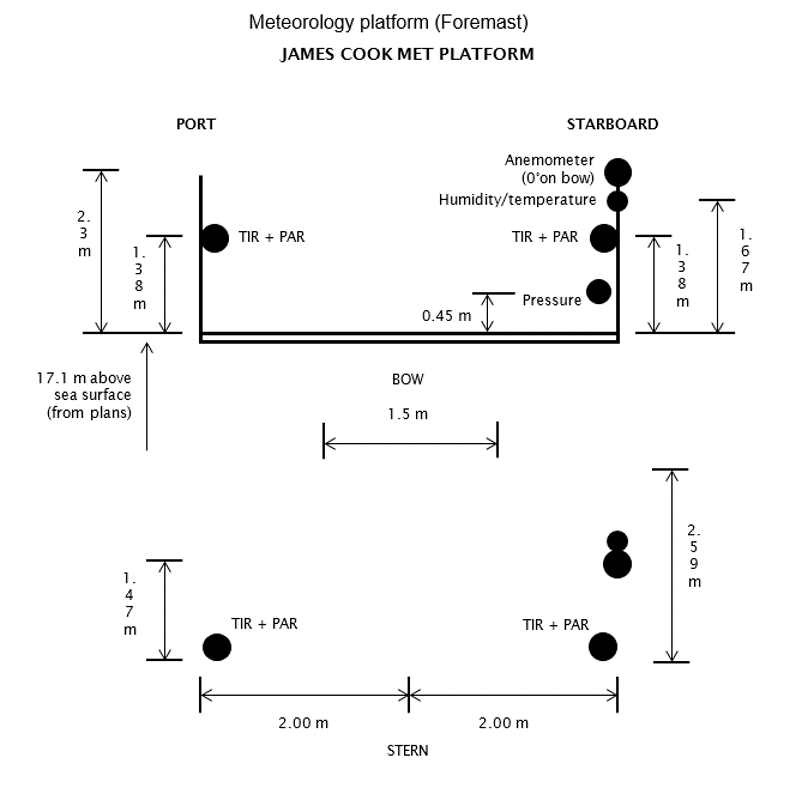 |
Skye Instruments PAR Energy Sensor Model SKE 510
The SKE 510 is suitable for measuring photosynthetically active radiation (PAR) from natural or artificial light sources. The sensor is fully waterproof and guaranteed submersible to 4m depth, and indoor versions are also available.
The instrument uses a blue-enhanced planar diffused silicon detector to measure energy (in W m-2) over the 400-700 nm waveband. It has a cosine-corrected head and a square spectral response. The sensor can operate over a temperature range of -35 to 70 °C and a humidity range of 0-100% RH.
Specifications
| Sensitivity (current) | 1.5µA or 100 W m-2 |
|---|---|
| Sensitivity (voltage) | 1mV or 100 W m-2 |
| Working Range | 0-5000 W m-2 |
| Linearity error | 0.2% |
| Absolute calibration error | typ. less than 3% 5% max |
| Response time - voltage output | 10 ns |
| Cosine error | 3% |
| Azimuth error | less than 1% |
| Temperature co-efficient | ±0.1% per °C |
| Internal resistance - voltage output | c. 300 ohms |
| Longterm stability | ±2% |
| Material | Dupont 'Delrin' |
| Dimensions | 34 mm diameter 38mm height |
| Cable | 2 core screened 7 - 2 - 2C |
| Sensor Passband | 400 - 700 nm |
| Detector | Silicon photocell |
| Filters | Glass type and/or metal interference |
Vaisala PTB110 barometer
An industrial, analog barometer which uses a silicon capacitive sensor (BAROCAP). The sensor produces either frequency or voltage output and is mountable on a (35 mm wide) DIN rail.
Operating ranges (1 hPa = 1 mbar)
| Pressure ranges | 500 ... 1100 hPa 600 ... 1100 hPa 800 ... 1100 hPa 800 ... 1060 hPa 600 ... 1060 hPa |
| Temperature range | -40 ... +60 °C (-40 ... +140 °F) |
| Humidity range | non-condensing |
General
| Output voltage | 0 ... 2.5 VDC 0 ... 5 VDC |
| Output frequency | 500 ... 1100 Hz |
| Resolution | 0.1 hPa |
Accuracy
| Linearity* | ±0.25 hPa |
| Hysteresis* | ±0.03 hPa |
| Repeatability* | ±0.03 hPa |
| Pressure calibration uncertainty** | ±0.15 hPa |
| Accuracy at +20 °C*** | ±0.3 hPa |
| Total accuracy at: | |
| +15 ... +25 °C (+59 ... +77 °F) 0 ... +40 °C (+32 ... +104 °F) -20 ... +45 °C (-4 ... +113 °F) -40 ... +60 °C (-40 ... +140 °F) | ±0.3 hPa ±0.6 hPa ±1.0 hPa ±1.5 hPa |
* Defined as ±2 standard deviation limits of end-point non-linearity, hysteresis error or repeatability error.
** Defined as ±2 standard deviation limits of inaccuracy of the working standard including traceability to NIST.
*** Defined as the root sum of the squares (RSS) of end-point non-linearity, hysteresis error, repeatability error and calibration uncertainty at room temperature when using voltage output.
More detailed information can be found in the manufacturer's data sheet and user's guide.
Vaisala Temperature and Relative Humidity HMP Sensors
A family of sensors and instruments (sensors plus integral displays or loggers) for the measurement of air temperature and relative humidity. All are based on a probe containing a patent (HUMICAP) capacitive thin polymer film capacitanece humidity sensor and a Pt100 platinum resistance thermometer. The probes are available with a wide range of packaging, cabling and interface options all of which have designations of the form HMPnn or HMPnnn such as HMP45 and HMP230. Vaisala sensors are incorporated into weather stations and marketed by Campbell Scientific.
All versions operate at up to 100% humidity. Operating temperature ranges vary between models, allowing users to select the version best suited to their requirements.
Further details can be found in the manufacturer's specification sheets for the HMP 45 series, HMP 70 series and HMP 230 series.
RRS James Cook cruise JC159 meteorology data processing procedures
Originator's Data Processing
The data were logged by the TECHSAS (TECHnical and Scientific sensors Acquisition System) version 5.11 data logging system which is the main data logging system on NMF-SS operated research vessels. Data were processed daily using the National Oceanography Centre MSTAR data processing routines into NetCDF files, and these TECHSAS MSTAR (NetCDF) meteorology files provided to BODC were used for BODC processing. Please refer to the cruise report for more information.
Files delivered to BODC
| Filename | Content description | Format | Interval | Start date/time (UTC) | End date/time (UTC) | Comments |
| met_light_jc159_01.nc | Air pressure, photosynthetically active radiation (PAR), total irradiance (TIR) | NetCDF | 1 second | 24/02/2018 21:28:50 | 08/04/2018 17:41:39 | - |
| surfmet_jc159_trueav.nc | True and relative wind speed and direction | NetCDF | 60 seconds | 24/02/2018 21:29:00 | 08/04/2018 00:00:00 | - |
| *-MET-SURFMET.SURFMETV2 | Relative humidity, wind speed and direction, and air temperature | NetCDF | 1 hz | 24/02/2018 21:28:49 | 11/04/2018 00:00:00 | - |
BODC Data Processing
The data were reformatted to the BODC internal format using standard banking procedures, and averaged at 60 second intervals. The following table shows how variables within the files were mapped to appropriate BODC parameter codes:
met_light_jc159_01.nc
| Originator's variable | Originator's units | Description | BODC Code | BODC Units | Unit conversion | Comments |
| pres | mbar | Air pressure | CAPHTU01 | mbar | N/A | - |
| ppar | hectokilovolts | PAR (port) | DVLTRPSD | volts | /100000 | - |
| spar | hectokilovolts | PAR (starboard) | DVLTRSSD | volts | /100000 | - |
| ptir | hectokilovolts | TIR (port) | CVLTRP01 | volts | /100000 | - |
| stir | hectokilovolts | TIR (starboard) | CVLTRS01 | volts | /100000 | - |
surfmet_jc159_trueav.nc
| Originator's variable | Originator's units | Description | BODC Code | BODC Units | Unit conversion | Comments |
| truwind_spd | m/s | True wind speed (data originator) | N/A | N/A | N/A | Not transferred in favour of version calculated by BODC |
| truwind_dir | degrees to | True wind direction (data originator) | N/A | N/A | N/A | Not transferred in favour of version calculated by BODC |
| relwind_spd | m/s | Relative wind speed | N/A | N/A | N/A | Not transferred in favour of version from TECHSAS file below |
| relwind_dirship | degrees relative to ship (0 = towards bow) | Relative wind direction | N/A | N/A | N/A | Not transferred in favour of version from TECHSAS file below |
*-MET-SURFMET.SURFMETV2
| Originator's variable | Originator's units | Description | BODC Code | BODC Units | Unit conversion | Comments |
| humid | % | Relative humidity | CRELZZ01 | % | N/A | - |
| airtemp | °C | Air temperature | CDTAZZ01 | °C | N/A | - |
| speed | m/s | Relative wind speed | ERWSSS01 | m/s | N/A | - |
| direct | degrees relative to ship (0 = from bow) | Relative wind direction | ERWDSS01 | degrees from | N/A | - |
All data expressed at measurement altitude.
Calibrations
Field Calibrations
No field calibrations were applied to the data at BODC.
Manufacturers Calibrations
Air pressure
A manufacturer's calibration was not applied to the Vaisala PTB110 barometer because there was no significant offset reported on the certified calibration certificate.
PAR/TIR
The following manufacturer's calibrations were applied to the PAR and TIR light sensors using:
y (W m -2 ) = (a x 10 6 )/b
Where 'a' is the raw data in volts and 'b' is the calibration offset (µV per W m -2 ) as shown below:
| Sensor | Serial No. | Location | Offset (µV per W m -2 ) |
| PAR | 28563 | Port | 10.49 |
| PAR | 28558 | Starboard | 10.84 |
| TIR | 994132 | Port | 11.31 |
| TIR | 994133 | Starboard | 9.67 |
Relative wind speed and direction
Relative wind speed and direction were corrected for the ship's heading and speed using the POS MV gyro heading, ship velocities (calculated at BODC from the main positional channels) and an anemometer orientation of 0° on the bow following the Shipboard Automated Meteorological and Oceanographic System (SAMOS) method, thus obtaining the BODC derived absolute wind speed and direction parameters, with codes EWSBSS01 and EWDASS01 respectively.
Relative humidity and air temperature
Manufacturer's calibrations were not applied to the Vaisala HMP45AL temperature and humidity probe data because there were no significant offsets reported on the certified calibration certificate.
Screening
All reformatted data were visualised using the in-house EDSERPLO software. Where calibrations had been applied, only the calibrated versions of those parameters were screened. Suspect data were marked by adding an appropriate quality control flag.
Project Information
Ocean Regulation of Climate by Heat and Carbon Sequestration and Transports (ORCHESTRA)
The Ocean Regulation of Climate by Heat and Carbon Sequestration and Transports (ORCHESTRA) is a £8.4 million, five year (2016-2021) research programme funded by the Natural Environment Research Council (NERC). The aim of the research is to to advance the understanding of, and capability to predict, the Southern Ocean's impact on climate change via its uptake and storage of heat and carbon. The programme will significantly reduce uncertainties concerning how this uptake and storage by the ocean influences global climate, by conducting a series of unique fieldwork campaigns and innovative model developments.
Background
ORCHESTRA represents the first fully-unified activity by NERC institutes to address these challenges, and will draw in national and international partners to provide community coherence, and to build a legacy in knowledge and capability that will transcend the timescale of the programme itself.
It brings together science teams from six UK research institutions to investigate the role that the Southern Ocean plays in our changing climate and atmospheric carbon draw-down. It is led by British Antarctic Survey, in partnership with National Oceanography Centre, British Geological Survey, Plymouth Marine Laboratory, the Centre for Polar Observation and Modelling and the Sea Mammal Research Unit.
The oceans around Antarctica play a critical a key role in drawing down and storing large amounts of carbon and vast quantities of heat from from the atmosphere. Due to its remoteness and harsh environment, the Southern Ocean is the world's biggest data desert, and one of the hardest places to get right in climate models. The ORCHESTRA programme will make unique and important new measurements in the Southern Ocean using a range of techniques, including use of the world-class UK research vessel fleet, and deployments of innovative underwater robots. The new understanding obtained will guide key improvements to the current generation of computer models, and will enhance greatly our ability to predict climate into the future.
The scope of the programme includes interaction of the Southern Ocean with the atmosphere, exchange between the upper ocean mixed layer and the interior and exchange between the Southern Ocean and the global ocean.
Further details are available on the ORCHESTRA page.
Participants
Six different organisations are directly involved in research for ORCHESTRA. These institutions are:
- British Antarctic Survey (BAS)
- National Oceanography Centre (NOC)
- Plymouth Marine Laboratory (PML)
- British Geological Survey (BGS)
- Centre for Polar Observation and Modelling (CPOM)
- Sea Mammal Research Unit (SMRU)
GO-SHIP are a third party organisation that, although not directly involved with the programme, will conduct ship based observations that will also be used by ORCHESTRA.
Research details
Three Work Packages have been funded by the ORCHESTRA programme. These are described in brief below:
-
Work Package 1: Interaction of the Southern ocean with the atmosphere
WP1 will use new observations of surface fluxes and their controlling parameters in order to better constrain the exchanges of heat and carbon loss across the surface of the Southern Ocean. -
Work Package 2: Exchange between the upper ocean mixed layer and the interior.
This work package will combine observationally-derived data and model simulations to determine and understand the exchanges between the ocean mixed layer and its interior. -
Work Package 3: Exchange between the Southern Ocean and the global ocean .
This WP will use budget analyses of the hydrographic/tracer sections to diagnose the three-dimensional velocity field of the waters entering, leaving and recirculating within the Southern Atlantic sector of the Southern ocean. -
Fieldwork and data collection
The campaign consists of 12 core cruises on board the NERC research vessels RRS James Clark Ross and RRS James Cook and will include hydrographic/tracer sections conducted across Drake Passage (SR1b), the northern Weddell Sea/Scotia Sea (A23), the northern rim of the Weddell Gyre (ANDREXII) and across the South Atlantic (24S). Section I6S will be performed by GO-SHIP Project Partners. Measurements will include temperature, salinity, dissolved oxygen, velocity, dissolved inorganic carbon, total alkalinity, inorganic nutrients, oxygen and carbon isotopes, and underway meteorological and surface ocean observations including pCO2.
Tags will be deployed on 30 Weddel seals and these will provide temperature and salinity profiles that can be used alongside the Argo data.
Autonomous underwater ocean gliders will conduct multi-month missions and will deliver data on ocean stratification, heat content, mixed layer depth and turbulent mixing over the upper 1 km, with previously-unobtainable temporal resolution. These gliders will be deployed in the Weddell Gyre and the ACC.
Field campaigns with the MASIN meteorological aircrafts will be conducted flying out of Rothera and Halley research stations and the Falkland Islands. These campaigns will deliver information on key variables relating to air-sea fluxes (surface and air temperature, wind, humidity, atmospheric CO2, radiation, turbulent fluxes of heat, momentum and CO2), in different sea ice conditions and oceanic regimes.
Eart Observation datasets will be used to inform the programme on the properties of the ocean, sea ice and atmosphere and on interactions between them.
A cluster of 6 deep ocean moorings in the Orkney Passage will collect year round series of AABW temperatre and transport. This work connects to the NERC funded project Dynamics of the Orkney Passage Outflow (DYNOPO).
The UK Earth System model (UKESM) and underlying physical model will be used to conduct analyses of heat and carbon uptake and transport by the Southern Ocean and their links to wider climate on decadal timescales.
An eddy-resolving (1/12°) sector model of the ocean south of 30°S with 75 vertical levels, will be built using the NEMO model coupled to the Los Alamos sea ice (CICE) model. The improvements on the ocean boundary layer will be based from the results from the NERC-funded OSMOSIS project and the inclusion of tides.
20-5 year runs of an adjoint model will be conducted to determine how key forcings and model states affect the uptake and subduction of heat and carbon by the ocean.
Data Activity or Cruise Information
Cruise
| Cruise Name | JC159 |
| Departure Date | 2018-02-28 |
| Arrival Date | 2018-04-10 |
| Principal Scientist(s) | Brian A King (National Oceanography Centre, Southampton) |
| Ship | RRS James Cook |
Complete Cruise Metadata Report is available here
Fixed Station Information
No Fixed Station Information held for the Series
BODC Quality Control Flags
The following single character qualifying flags may be associated with one or more individual parameters with a data cycle:
| Flag | Description |
|---|---|
| Blank | Unqualified |
| < | Below detection limit |
| > | In excess of quoted value |
| A | Taxonomic flag for affinis (aff.) |
| B | Beginning of CTD Down/Up Cast |
| C | Taxonomic flag for confer (cf.) |
| D | Thermometric depth |
| E | End of CTD Down/Up Cast |
| G | Non-taxonomic biological characteristic uncertainty |
| H | Extrapolated value |
| I | Taxonomic flag for single species (sp.) |
| K | Improbable value - unknown quality control source |
| L | Improbable value - originator's quality control |
| M | Improbable value - BODC quality control |
| N | Null value |
| O | Improbable value - user quality control |
| P | Trace/calm |
| Q | Indeterminate |
| R | Replacement value |
| S | Estimated value |
| T | Interpolated value |
| U | Uncalibrated |
| W | Control value |
| X | Excessive difference |
SeaDataNet Quality Control Flags
The following single character qualifying flags may be associated with one or more individual parameters with a data cycle:
| Flag | Description |
|---|---|
| 0 | no quality control |
| 1 | good value |
| 2 | probably good value |
| 3 | probably bad value |
| 4 | bad value |
| 5 | changed value |
| 6 | value below detection |
| 7 | value in excess |
| 8 | interpolated value |
| 9 | missing value |
| A | value phenomenon uncertain |
| B | nominal value |
| Q | value below limit of quantification |