Metadata Report for BODC Series Reference Number 2042201
Metadata Summary
Problem Reports
Data Access Policy
Narrative Documents
Project Information
Data Activity or Cruise Information
Fixed Station Information
BODC Quality Flags
SeaDataNet Quality Flags
Metadata Summary
Data Description |
|||||||||||||||||||||||||||||||||||||||||||||||||||||||||||||||||||||||||||||||||||||||||||||
|
|||||||||||||||||||||||||||||||||||||||||||||||||||||||||||||||||||||||||||||||||||||||||||||
Data Identifiers |
|||||||||||||||||||||||||||||||||||||||||||||||||||||||||||||||||||||||||||||||||||||||||||||
|
|||||||||||||||||||||||||||||||||||||||||||||||||||||||||||||||||||||||||||||||||||||||||||||
Time Co-ordinates(UT) |
|||||||||||||||||||||||||||||||||||||||||||||||||||||||||||||||||||||||||||||||||||||||||||||
|
|||||||||||||||||||||||||||||||||||||||||||||||||||||||||||||||||||||||||||||||||||||||||||||
Spatial Co-ordinates | |||||||||||||||||||||||||||||||||||||||||||||||||||||||||||||||||||||||||||||||||||||||||||||
|
|||||||||||||||||||||||||||||||||||||||||||||||||||||||||||||||||||||||||||||||||||||||||||||
Parameters |
|||||||||||||||||||||||||||||||||||||||||||||||||||||||||||||||||||||||||||||||||||||||||||||
|
|||||||||||||||||||||||||||||||||||||||||||||||||||||||||||||||||||||||||||||||||||||||||||||
|
|||||||||||||||||||||||||||||||||||||||||||||||||||||||||||||||||||||||||||||||||||||||||||||
Problem Reports
No Problem Report Found in the Database
Data Access Policy
Open Data
These data have no specific confidentiality restrictions for users. However, users must acknowledge data sources as it is not ethical to publish data without proper attribution. Any publication or other output resulting from usage of the data should include an acknowledgment.
If the Information Provider does not provide a specific attribution statement, or if you are using Information from several Information Providers and multiple attributions are not practical in your product or application, you may consider using the following:
"Contains public sector information licensed under the Open Government Licence v1.0."
Narrative Documents
Nortek Signature 250 acoustic doppler current profiler
An Acoustic Doppler Current Profiler (ADCP) for use in: currents; waves; tidal; and ice drift and draft studies. It consists of up to five acoustic transducers, four standard beams slanted at 20 degrees from vertical, and a fifth optional vertical beam. All beams operate at the same frequency of 250kHz. The instrument has integrated pressure and temperature sensors.
For more information, please see this document: https://www.bodc.ac.uk/data/documents/nodb/pdf/NortekSignature250ADCP.pdf
SOLSTICE-WIO EK181 CR2 Moored ADCP Data: BODC Processing
The moored ADCP data were supplied to BODC as one MatLab file and was converted to the BODC internal format. During transfer, the originator's variables were mapped to unique BODC parameter codes. The following table shows the parameter mapping:
| Originator's variable | Units | BODC Code | Units | Comments |
|---|---|---|---|---|
| time | matlab time | - | - | - |
| press | dbar | PREXISPS | dB | - |
| depth | m | PPSAPR01 | m | - |
| heading | deg | HEADCM01 | degrees | - |
| pitch | deg | PTCHGP01 | degrees | - |
| roll | deg | ROLLGP01 | degrees | - |
| temp | deg C | TEMPTC01 | Degrees Celsius | - |
| v | cm/s | LCNSAP01 | cm/s | - |
| u | cm/s | LCEWAP01 | cm/s | - |
| w1 | cm/s | LRZAAP02 | cm/s | - |
| w2 | cm/s | LRZAAP03 | cm/s | - |
| errorv | cm/s | LERRAP01 | cm/s | - |
| a1 | dbar | ASAMAP00 | dB | - |
| a2 | dbar | ASAMAP02 | dB | - |
| a3 | dbar | ASAMAP03 | dB | - |
| a4 | dbar | ASAMAP04 | dB | - |
| pgood | % | PCGDAP06 | % | - |
| coravg | % | CMAGZZ06 | % | - |
| binrange | m | - | - | Not Transferred |
| depthrange | m | DBINAA01 | - | - |
Following transfer, the data were screened using BODC in-house visualisation software. Improbable data values were assigned the appropriate BODC data quality flag. Missing data values, where present, were changed to the missing data value and assigned a BODC data quality flag.
SOLSTICE-WIO EK181 CR2 Moored ADCP Data: Originator's Processing
Sampling Strategy
A Nortek Signature 250 ADCP (s/n: 100742) was mounted in a bottom float and fitted to the Cold Ridge 2 (CR2) mooring at depth of 99 m. The instrument was configured to sample at regular 10-minute intervals for a period of approximately 5 months. A detailed mooring diagram is available in the recovery cruise report.
The CR2 mooring was deployed at a nominal position of -34.556°S and 22.5165°E on the 17th of October 2018 during R.S. Ellen Khuzwayo cruise EK181 and recovered on the 30th March 2019 during R.S. Ellen Khuzwayo cruise EK188.
Data Acquisition
Upon recovery, the complete dataset was successfully downloaded from the ADCP.
Project Information
SOLSTICE-WIO: Sustainable Oceans, Livelihoods and food Security Through Increased Capacity in Ecosystem research in the Western Indian Ocean
Introduction
SOLSTICE-WIO is a four-year collaborative project funded by the UK Global Challenges Research Fund (GCRF). Launched in October 2017, it brings together recent advances in marine technologies, local knowledge and research expertise to address challenges facing the Western Indian Ocean region in a cost-effective way via state-of-the-art technology transfer, collaborative environmental and socio-economic research and hands-on training.
Over 100 million people in the Western Indian Ocean (WIO) region live within 100km of the coast, with over 1 million working in the fisheries sector. The WIO is highly dependent on the ocean for economic stability, food security, and social cohesion. In recent years, the region has seen dramatic and often poorly understood reductions in key fisheries, due to the combined effects of climate change, natural ecosystem variability, overfishing and degradation of key marine habitats. Until the mechanisms behind the collapse are understood, there is little potential for aiding recovery or guiding adaptation. The key to stability of living marine resources lies in an ecosystem approach to fisheries (EAF), which sees human-natural systems as a whole, integrated entity rather than separately considering individual target species. Understanding and managing WIO fisheries and the impacts of recent and future changes requires a mature capacity to implement an ecosystem approach to fisheries management (EAF) that is built on sound environmental and socio-economic information.
The core strength of SOLSTICE-WIO lies in its integral approach to food security, drawing on UK expertise in physical oceanography, marine ecology, autonomous observations, environmental economics and the human dimension,and WIO expertise in fisheries, the marine economy and regional policy development. SOLSTICE will provide the region with the state-of-the-art technology to deliver cost-effective marine research and provide the information needed to achieve maximum potential from the region's living marine resources. In the UK marine robotics, ocean models and novel data products from satellite observations have developed rapidly in the last decade, and now underpin Blue Economies and Ocean Governance in Europe. These technologies are highly agile and ready to be applied in the developing world as cost-effective ways to maximise understanding and sustainable exploitation of living marine resources. Such "technology leapfrogging" can overcome the severe lack of research ships in the WIO and save decades of effort in developing predictive modelling systems from scratch.
Scientific Objectives
SOLSTICE-WIO main objectives are to:
- Grow marine environmental research capability to address challenges facing the WIO region in a cost-effective way via state-of-the-art technology transfer, collaborative environmental and socio-economic research, and hands-on training.
- Strengthen the capacity of UK marine scientists to apply leading-edge technologies in developing countries, and work with regional and local experts to ensure that their research addresses local and regional needs.
- Strengthen the ability of WIO scientists to effectively deliver evidence-based environmental and socio-economic information to support policy development and implementation at national and regional levels.
- Ensure future sustainability of marine research capability in the region by training and mentoring early career scientists and post-graduate students from the WIO and by developing on-line resources for use in distance learning and hands-on training of marine scientists outside the partner organisations and beyond the duration of the project.
- Ensure on-going support for an Ecosystem Approach to Fisheries in the WIO by building lasting strategic research partnerships between UK marine science and regional centres of excellence, between these centres and other WIO research organisations, and between marine scientist and government agencies and NGOs mandated to deliver sustainable development and exploitation of marine living resources in the WIO.
Fieldwork
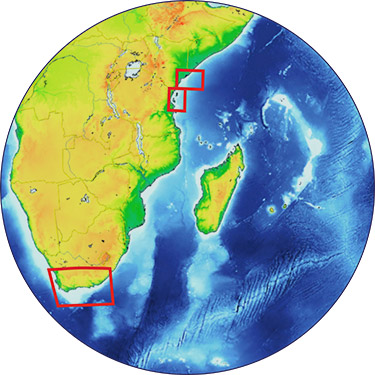
SOLSTICE-WIO will demonstrate its approach to strengthening research capacity through three case studies in Kenya, Tanzania and South Africa. These have been selected by SOLSTICE-WIO partners in each of the three countries.
-
Tanzania Case Study: Pemba Channel small pelagic fishery under climate threat.
The small pelagic fishery is important for local communities in Zanzibar and mainland Tanzania as a source of food security, nutrition and livelihood support. This diverse group includes mackerel, sardines and anchovies â?? found in schools over the continental shelf, in bays and deep lagoons with nutrient rich waters. They are more abundant during the southeast monsoon, when stronger winds drive upwelling that brings nutrient rich water to the surface.
Despite its importance for coastal economies, there is a lack of data and information about the fishery, which hampers effective management. Using robotics, modelling, remote sensing, field observations and socio-economic studies, SOLSTICE will identify key environmental and anthropogenic drivers of the main species and address climatic pressures on this fishery.
-
Kenya Case Study: Emerging fishery of the North Kenya Bank, an opportunity for coastal populations.
The North Kenya Bank fishery is expected to spur economic growth for local communities. If well managed, it could help achieve national development goals, including poverty alleviation and wealth creation. Sustainability requires informed management interventions, but there is only scant information on the ecological status and drivers of the fishery.
Using modelling, remote sensing, field observations and socio-economic studies, SOLSTICE will explore processes related to productivity and resilience of the ecosystems supporting the fishery, identify the main drivers of variability and change, and advise the fishery and government on how to optimise use of this important resource.
-
South Africa Case Study: Environmental drivers and socio-economic consequences of the South African Chokka squid fishery collapsing.
The collapse of the Chokka squid fishery in 2013 had a devastating effect on the Eastern Cape, one of the poorest provinces in South Africa. The reasons for the collapse are unknown, although local fishermen believe it happened as a result of environmental change.
SOLSTICE will address key environmental and anthropogenic factors controlling the ecosystem dynamics of the Agulhas Bank. The results will help explain why the fishery collapsed, and inform the fishery and government as to whether the current recovery is stable, or whether similar collapses are likely in the future.
Project Collaborators
The science delivered as part of SOLSTICE-WIO is greatly enhanced by the collaboration of the following institutions:
- National Oceanography Centre (NOC)
- Plymouth Marine Laboratory (PML)
- Scottish Association for Marine Science (SAMS)
- Heriot-Watt University
- Imperative Space
- Nelson Mandela University (NMU)
- South African Squid Management Industry Association
- Rhodes University
- South African Environmental Observation Network
- University of Cape Town
- Institute of Marine Sciences (IMS)
- Western Indian Ocean Marine Science Association
- Tanzania Fisheries Research Institute (TAFIRI)
- Environment for Development - Tanzania (EfDT)
- WWF Tanzania
- Kenya Marine and Fisheries Research Institute (KMFRI)
- Coastal Oceans Research and Development â?? Indian Ocean
- University of Seychelles
- Mozambique National Institute of Fisheries Research
- Institut Halieutique et des Sciences Marines (IH.SM)
SOLSTICE-WIO Leadership Team
Directors
- Prof Mike Roberts (Nelson Mandela University (NMU), South Africa)
- Dr Katya Popova (National Oceanography Centre (NOC), UK)
Members
- Prof Julius Francis (Western Indian Ocean Marine Science Association (WIOMSA), Tanzania)
- Dr Yohana W. Shaghude (Institute of Marine Sciences (IMS), Tanzania)
- Dr Baraka Sekadende (Tanzania Fisheries Research Institute (TAFIRI), Tanzania)
- Dr Joseph Kamau (Kenya Marine and Fisheries Research Institute (KMFRI), Kenya)
- Prof Warwick Sauer (Rhodes University (Rhodes), South Africa)
- Dr Eleni Papathanasopoulou (Plymouth Marine Laboratory (PML), UK)
- Dr Matthew Palmer (National Oceanography Centre (NOC), UK)
- Dr Val Byfield (National Oceanography Centre (NOC), UK)
- Sofia Alexiou (National Oceanography Centre (NOC), UK)
Funding
This is a NERC funded research project. The total value of the grant is £6,934,488 and the period of award is from September 4th 2017 to March 3rd 2020. NERC Reference: NE/P021050/1
Data Activity or Cruise Information
Data Activity
| Start Date (yyyy-mm-dd) | 2018-10-17 |
| End Date (yyyy-mm-dd) | 2019-03-30 |
| Organization Undertaking Activity | Nelson Mandela University, Institute for Coastal and Marine Research |
| Country of Organization | South Africa |
| Originator's Data Activity Identifier | CR2_102018 |
| Platform Category | subsurface mooring |
SOLSTICE-WIO Moored Instrument Rig CR2
This rig was deployed as part of the SOLSTICE-WIO project's Cold Ridge Mooring Deployment, offshore of Mossel Bay, Agulhas Bank, South Africa. 'CR2' refers to the deployment station name.
Data summary
| Deployment cruise | Ellen Khuzwayo EK181 |
| Recovery cruise | Ellen Khuzwayo EK188 |
| Rig position | -34.556°S 22.5165°E |
| Water depth | 102 m |
| Deployed | 17th October 2018 |
| Recovered | 30th March 2019 |
Instrumentation
The subsurface mooring was weighted with a 400 kg anchor and an acoustic release. A bottom float was positioned approximately 3 metres above the seabed, with the ADCP at this same position on the mooring. A smaller mid float and top float were also used, with 9 temperature sensors mounted in between. A detailed mooring diagram is available in the recovery cruise report.
Instruments on the subsurface mooring are listed below:
| Instrument | Serial number | Nominal depth |
| Star-Oddi Starmon TD temperature depth logger | 0100 | 18 m |
| Star-Oddi Starmon mini temperature recorder | 5749 | 25 m |
| Star-Oddi Starmon mini temperature recorder | 5750 | 32 m |
| Star-Oddi Starmon mini temperature recorder | 5751 | 39 m |
| Star-Oddi Starmon mini temperature recorder | 5752 | 46 m |
| Star-Oddi Starmon mini temperature recorder | 5753 | 53 m |
| Star-Oddi Starmon mini temperature recorder | 5754 | 60 m |
| Star-Oddi Starmon mini temperature recorder | 5755 | 75 m |
| Star-Oddi Starmon mini temperature recorder | 5756 | 90 m |
| Nortek Signature 250 ADCP | 100742 | 99 m |
Related Data Activity activities are detailed in Appendix 1
Cruise
| Cruise Name | EK188 |
| Departure Date | 2019-03-21 |
| Arrival Date | 2019-04-02 |
| Principal Scientist(s) | Margaux Noyon (Nelson Mandela University, Institute for Coastal and Marine Research) |
| Ship | Ellen Khuzwayo |
Complete Cruise Metadata Report is available here
Fixed Station Information
No Fixed Station Information held for the Series
BODC Quality Control Flags
The following single character qualifying flags may be associated with one or more individual parameters with a data cycle:
| Flag | Description |
|---|---|
| Blank | Unqualified |
| < | Below detection limit |
| > | In excess of quoted value |
| A | Taxonomic flag for affinis (aff.) |
| B | Beginning of CTD Down/Up Cast |
| C | Taxonomic flag for confer (cf.) |
| D | Thermometric depth |
| E | End of CTD Down/Up Cast |
| G | Non-taxonomic biological characteristic uncertainty |
| H | Extrapolated value |
| I | Taxonomic flag for single species (sp.) |
| K | Improbable value - unknown quality control source |
| L | Improbable value - originator's quality control |
| M | Improbable value - BODC quality control |
| N | Null value |
| O | Improbable value - user quality control |
| P | Trace/calm |
| Q | Indeterminate |
| R | Replacement value |
| S | Estimated value |
| T | Interpolated value |
| U | Uncalibrated |
| W | Control value |
| X | Excessive difference |
SeaDataNet Quality Control Flags
The following single character qualifying flags may be associated with one or more individual parameters with a data cycle:
| Flag | Description |
|---|---|
| 0 | no quality control |
| 1 | good value |
| 2 | probably good value |
| 3 | probably bad value |
| 4 | bad value |
| 5 | changed value |
| 6 | value below detection |
| 7 | value in excess |
| 8 | interpolated value |
| 9 | missing value |
| A | value phenomenon uncertain |
| B | nominal value |
| Q | value below limit of quantification |
Appendix 1: CR2_102018
Related series for this Data Activity are presented in the table below. Further information can be found by following the appropriate links.
If you are interested in these series, please be aware we offer a multiple file download service. Should your credentials be insufficient for automatic download, the service also offers a referral to our Enquiries Officer who may be able to negotiate access.
| Series Identifier | Data Category | Start date/time | Start position | Cruise |
|---|---|---|---|---|
| 2042342 | Hydrography time series at depth | 2018-10-17 13:00:00 | 34.556 S, 22.5165 E | Ellen Khuzwayo EK188 |
| 2042354 | Hydrography time series at depth | 2018-10-17 13:00:00 | 34.556 S, 22.5165 E | Ellen Khuzwayo EK188 |
| 2042366 | Hydrography time series at depth | 2018-10-17 13:00:00 | 34.556 S, 22.5165 E | Ellen Khuzwayo EK188 |
| 2042378 | Hydrography time series at depth | 2018-10-17 13:00:00 | 34.556 S, 22.5165 E | Ellen Khuzwayo EK188 |
| 2042391 | Hydrography time series at depth | 2018-10-17 13:00:00 | 34.556 S, 22.5165 E | Ellen Khuzwayo EK188 |
| 2042409 | Hydrography time series at depth | 2018-10-17 13:00:00 | 34.556 S, 22.5165 E | Ellen Khuzwayo EK188 |
| 2042410 | Hydrography time series at depth | 2018-10-17 13:00:00 | 34.556 S, 22.5165 E | Ellen Khuzwayo EK188 |
| 2042422 | Hydrography time series at depth | 2018-10-17 13:00:00 | 34.556 S, 22.5165 E | Ellen Khuzwayo EK188 |
| 2042434 | Hydrography time series at depth | 2018-10-17 13:00:00 | 34.556 S, 22.5165 E | Ellen Khuzwayo EK188 |