
Metadata Report for BODC Series Reference Number 2207242
Metadata Summary
Problem Reports
Data Access Policy
Narrative Documents
Project Information
Data Activity or Cruise Information
Fixed Station Information
BODC Quality Flags
SeaDataNet Quality Flags
Metadata Summary
Data Description |
|||||||||||||||||||||||||||||||||||||||||||||||||||||||||||||||||||||||||||||||||
|
|||||||||||||||||||||||||||||||||||||||||||||||||||||||||||||||||||||||||||||||||
Data Identifiers |
|||||||||||||||||||||||||||||||||||||||||||||||||||||||||||||||||||||||||||||||||
|
|||||||||||||||||||||||||||||||||||||||||||||||||||||||||||||||||||||||||||||||||
Time Co-ordinates(UT) |
|||||||||||||||||||||||||||||||||||||||||||||||||||||||||||||||||||||||||||||||||
|
|||||||||||||||||||||||||||||||||||||||||||||||||||||||||||||||||||||||||||||||||
Spatial Co-ordinates | |||||||||||||||||||||||||||||||||||||||||||||||||||||||||||||||||||||||||||||||||
|
|||||||||||||||||||||||||||||||||||||||||||||||||||||||||||||||||||||||||||||||||
Parameters |
|||||||||||||||||||||||||||||||||||||||||||||||||||||||||||||||||||||||||||||||||
|
|||||||||||||||||||||||||||||||||||||||||||||||||||||||||||||||||||||||||||||||||
|
|||||||||||||||||||||||||||||||||||||||||||||||||||||||||||||||||||||||||||||||||
Problem Reports
No Problem Report Found in the Database
Data Access Policy
Open Data
These data have no specific confidentiality restrictions for users. However, users must acknowledge data sources as it is not ethical to publish data without proper attribution. Any publication or other output resulting from usage of the data should include an acknowledgment.
If the Information Provider does not provide a specific attribution statement, or if you are using Information from several Information Providers and multiple attributions are not practical in your product or application, you may consider using the following:
"Contains public sector information licensed under the Open Government Licence v1.0."
Narrative Documents
DY040 Underway Document
Cruise details
| Cruise | RRS Discovery DY040 |
|---|---|
| Dates | 6th December 2015 - 22nd January 2016 (UTC) |
| Principal Scientific Officer | Brian King (National Oceanography Centre) |
| Embarkation Port | Nassau, Bahamas |
| Disembarkation Port | Las Palmas, Spain |
DY040 Underway Meteorology Instrumentation
Instrumentation
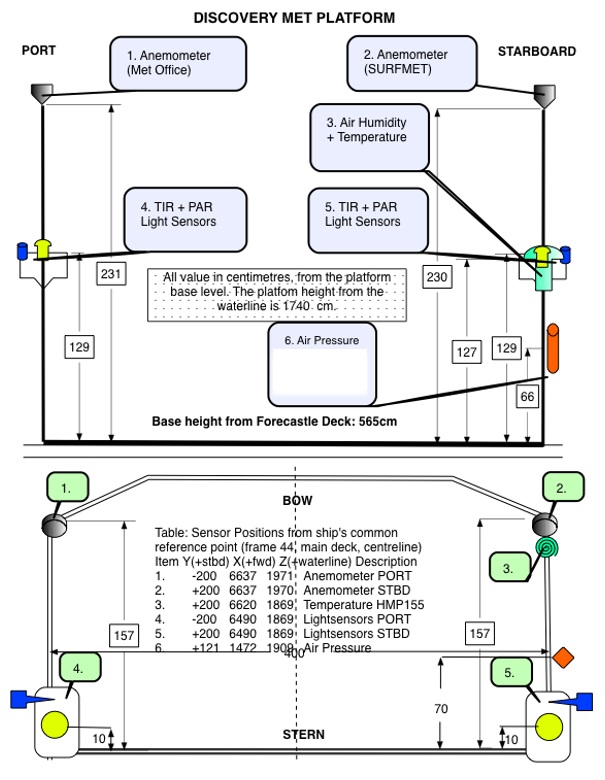
The meteorological suite of sensors was located on the forecastle deck, between 18.06 and 19.71 m above sea level. The anemometer orientation was 0° on the bow.
| Manufacturer | Model | Main Function | Serial number | Last calibration date | Comments |
| Skye | SKE 510 | Photosynthetically Active Radiation (PAR) | 28561 | 30/04/2014 (2 yr) | Port |
| Skye | SKE 510 | Photosynthetically Active Radiation (PAR) | 28563 | 20/02/2014 (2 yr) | Starboard |
| Kipp & Zonen | CM 6B | Total Incident Radiation (TIR) | 973134 | 19/03/2015 (2 yr) | Port |
| Kipp & Zonen | CM 6B | Total Incident Radiation (TIR) | 962276 | 13/04/2014 (2 yr) | Starboard |
| Gill | WindSonic | Wind speed & direction | 10280018 | 28/09/2015 | Tested and within tolerance. |
| Vaisala | HMP155 | Air temperature & humidity | K0950058 | 16/01/2015 | Tested and within tolerance. |
| Vaisala | PTB110 | Air pressure | L0650612 | 06/02/2015 | Tested and within tolerance. |
 |
Gill Instruments Windsonic Anemometer
The Gill Windsonic is a 2-axis ultrasonic wind sensor that monitors wind speed and direction using four transducers. The time taken for an ultrasonic pulse to travel from the North to the South transducers is measured and compared with the time for a pulse to travel from South to North. Travel times between the East and West transducers are similarly compared. The wind speed and direction are calculated from the differences in the times of flight along each axis. This calculation is independent of environmental factors such as temperature.
Specifications
| Ultrasonic output rate | 0.25, 0.5, 1, 2 or 4 Hz |
| Operating Temperature | -35 to 70°C |
| Operating Humidity | < 5 to 100% RH |
| Anemometer start up time | < 5 s |
| Wind speed | |
| Range | 0 to 60 m s-1 |
| Accuracy | ± 2% at 2 m s-1 |
| Resolution | 0.01 m s-1 |
| Response time | 0.25 s |
| Threshold | 0.01 m s-1 |
| Wind direction | |
| Range | 0 to 359° |
| Accuracy | ± 3° at 12 m s-1 |
| Resolution | 1° |
| Response time | 0.25 s |
Further details can be found in the manufacturer's specification sheet.
Kipp and Zonen Pyranometer Model CM6B
The CM6B pyranometer is intended for routine global solar radiation measurement research on a level surface. The CM6B features a sixty-four thermocouple junction (series connected) sensing element. The sensing element is coated with a highly stable carbon based non-organic coating, which delivers excellent spectral absorption and long term stability characteristics. The sensing element is housed under two concentric fitting Schott K5 glass domes.
Specifications
| Dimensions (W x H) | 150.0 mm x 91.5 mm |
|---|---|
| Weight | 850 grams |
| Operating Temperature | -40°C to +80°C |
| Spectral Range | 305 - 2800 nm (50% points) |
| Sensitivity | 9 -15 µV/W/m2 |
| Impedance (nominal) | 70 - 100 ohm |
| Response Time (95%) | 30 sec |
| Non-linearity | < ± 1.2% (<1000 W/m2) |
| Temperature dependence of sensitivity | < ± 2% (-10 to +40°C) |
| Zero-offset due to temperature changes | < ± 4 W/m2 at 5 K/h temperature change |
Skye Instruments PAR Energy Sensor Model SKE 510
The SKE 510 is suitable for measuring photosynthetically active radiation (PAR) from natural or artificial light sources. The sensor is fully waterproof and guaranteed submersible to 4m depth, and indoor versions are also available.
The instrument uses a blue-enhanced planar diffused silicon detector to measure energy (in W m-2) over the 400-700 nm waveband. It has a cosine-corrected head and a square spectral response. The sensor can operate over a temperature range of -35 to 70 °C and a humidity range of 0-100% RH.
Specifications
| Sensitivity (current) | 1.5µA or 100 W m-2 |
|---|---|
| Sensitivity (voltage) | 1mV or 100 W m-2 |
| Working Range | 0-5000 W m-2 |
| Linearity error | 0.2% |
| Absolute calibration error | typ. less than 3% 5% max |
| Response time - voltage output | 10 ns |
| Cosine error | 3% |
| Azimuth error | less than 1% |
| Temperature co-efficient | ±0.1% per °C |
| Internal resistance - voltage output | c. 300 ohms |
| Longterm stability | ±2% |
| Material | Dupont 'Delrin' |
| Dimensions | 34 mm diameter 38mm height |
| Cable | 2 core screened 7 - 2 - 2C |
| Sensor Passband | 400 - 700 nm |
| Detector | Silicon photocell |
| Filters | Glass type and/or metal interference |
Vaisala HMP 155 hygrometer series
A series of sensors that measure relative humidity and temperature. It is designed for outdoor applications. Alternative humidity variables are also reported (dew point/frostpoint temperature, wet bulb temperature, mixing ratio). Humidity measurement on the sensor is based on the capacitive thin film polymer HUMICAP sensor. Temperature measurement is based on platinum resistance (Pt100 RTD element, Class F 0.1 IEC 60751) sensors. The sensor is installed inside a radiation shield and is fitted with a digital RS-485 output. Active output and passive output models are available. The instrument can be fitted with standard humidity sensors, composite humidity sensors that are also suitable for heated applications or sensors resistant to chemical interfacing (INTERCAP, HUMICAP180R, HUMICAPR2, HUMICAP180C, HUMICAP180RC, HUMICAPR2C) It may also be fitted with an additional temperature sensor for enhanced temperature response. Several voltage output signal ranges: 0 -1 V, 0-5 V, 0-10 V. HMP155 replaces the HMP45 series of sensors.
For more information, please see these documents:
https://www.bodc.ac.uk/data/documents/nodb/pdf/Vaisala-HMP155-Datasheet-B210752EN.pdf
Vaisala PTB110 barometer
An industrial, analog barometer which uses a silicon capacitive sensor (BAROCAP). The sensor produces either frequency or voltage output and is mountable on a (35 mm wide) DIN rail.
Operating ranges (1 hPa = 1 mbar)
| Pressure ranges | 500 ... 1100 hPa 600 ... 1100 hPa 800 ... 1100 hPa 800 ... 1060 hPa 600 ... 1060 hPa |
| Temperature range | -40 ... +60 °C (-40 ... +140 °F) |
| Humidity range | non-condensing |
General
| Output voltage | 0 ... 2.5 VDC 0 ... 5 VDC |
| Output frequency | 500 ... 1100 Hz |
| Resolution | 0.1 hPa |
Accuracy
| Linearity* | ±0.25 hPa |
| Hysteresis* | ±0.03 hPa |
| Repeatability* | ±0.03 hPa |
| Pressure calibration uncertainty** | ±0.15 hPa |
| Accuracy at +20 °C*** | ±0.3 hPa |
| Total accuracy at: | |
| +15 ... +25 °C (+59 ... +77 °F) 0 ... +40 °C (+32 ... +104 °F) -20 ... +45 °C (-4 ... +113 °F) -40 ... +60 °C (-40 ... +140 °F) | ±0.3 hPa ±0.6 hPa ±1.0 hPa ±1.5 hPa |
* Defined as ±2 standard deviation limits of end-point non-linearity, hysteresis error or repeatability error.
** Defined as ±2 standard deviation limits of inaccuracy of the working standard including traceability to NIST.
*** Defined as the root sum of the squares (RSS) of end-point non-linearity, hysteresis error, repeatability error and calibration uncertainty at room temperature when using voltage output.
More detailed information can be found in the manufacturer's data sheet and user's guide.
DY040 Underway Meteorology Data Processing Procedures
Originator's Data Processing
The data were logged by the TECHSAS (TECHnical and Scientific sensors Acquisition System) version 5.7 data logging system which is the main data logging system on NMF-SS operated research vessels. Data were processed daily using the National Oceanography Centre data processing routines into NetCDF files, and these TECHSAS (NetCDF) navigation and bathymetry files provided to BODC were used for BODC processing, in addition to MSTAR files, processed by the originator. Please refer to the DY040 cruise report for more information. Relative wind speed and direction were corrected by the originator for the ship's heading and speed using the POSMV gyro heading, ship velocities (calculated from the main positional channels) and an anemometer orientation of 0° on the bow.
Files delivered to BODC
| Filename | Content description | Format | Interval | Start date/time (UTC) | End date/time (UTC) | Comments |
| *-*-MET-DY-SM_DY1.SURFMETv2 | Air temperature, humidity | NetCDF | 1 sec | 03-Dec-2015 17:39:21 | 22-Jan-2016 08:12:00 | |
| *-*- Light-DY-SM_DY1.SURFMETv2 | Air pressure, PAR, TIR | NetCDF | 1 sec | 03-Dec-2015 17:39:21 | 22-Jan-2016 08:12:00 | |
| met _dy040_trueav.nc | True wind speed and direction | MSTAR | 1 min | 03-Dec-2015 17:39:00 | 22-Jan-2016 08:12:00 |
BODC Data Processing
The data were reformatted to BODC internal format using standard banking procedures. Data were averaged at 60 second intervals. The following table shows how variables within the file were mapped to appropriate BODC parameter codes:
met_dy040_trueav.nc
| Originator's variable | Originator's units | Description | BODC Code | BODC Units | Unit conversion | Comments |
| Truwind_dir | degrees | True wind direction | ERWDSS01 | degrees true | none | |
| Truwind_spd | m/s | True wind speed | ERWSSS01 | m/s | none |
*-*-MET-DY-SM_DY1.SURFMETv2
| Originator's variable | Originator's units | Description | BODC Code | BODC Units | Unit conversion | Comments |
| airtemp | degree celsius | Air temperature | CDTAZZ01 | degrees celsius | none | |
| humid | % | Relative air humidity | CRELZZ01 | % | none | |
| direct | degrees | Relative wind direction | ERWDSS01 | degrees | none |
*-*- Light-DY-SM_DY1.SURFMETv2
| Originator's variable | Originator's units | Description | BODC Code | BODC Units | Unit conversion | Comments |
| ptir | Volt x 105 | Port total irradiance | CVLTRP01 | Volts | *0.00001 | |
| stir | Volt x 105 | Starboard total irradiance | CVLTRS01 | Volts | *0.00001 | |
| ppar | Volt x 105 | Port side PAR sensor | DVLTRPSD | Volts | *0.00001 | |
| spar | Volt x 105 | Starboard side starboard sensor | DVLTRSSD | Volts | *0.00001 | |
| pres | mbar | Atmospheric pressure | CAPHTU01 | millibar | none |
All data expressed at measurement altitude.
Calibrations
Field Calibrations
No field calibrations were applied to the data at BODC.
Manufacturers Calibrations
Air pressure
A manufacturer's calibration was not applied to the Vaisala PTB110 barometer because there was no significant offset reported on the certified calibration certificate.
PAR/TIR
The following manufacturer's calibrations were applied to the PAR and TIR light sensors using:
y (W m -2) = (a x 10 6)/b
Where 'a' is the raw data in volts and 'b' is the calibration offset (µV per W m -2) as shown below:
| Sensor | Serial No. | Location | Offset (µV per W m -2 ) |
| PAR | 28563 | Port | 10.93 |
| PAR | 28561 | Starboard | 10.05 |
| TIR | 973134 | Port | 10.97 |
| TIR | 962276 | Starboard | 10.14 |
Relative humidity and air temperature
Manufacturer's calibrations were not applied to the Vaisala HMP155 temperature and humidity probe data because there were no significant offsets reported on the certified calibration certificate.
Screening
All reformatted data were visualised using the in-house EDSERPLO software. Where calibrations had been applied, only the calibrated versions of those parameters were screened. Suspect data were marked by adding an appropriate quality control flag. The port PAR instrument experienced a lot of noise overnight during dark hours throughout the cruise. A small number of periods of ship speed artificial acceleration of wind speed data were flagged, in addition to effects of wind shielding from the ship's superstructure on meteorological parameters. All of these incidences were flagged with a BODC 'M' flag. Some incidences of transient shading in both the port and starboard PAR and TIR sensors were flagged. Air temperature, atmospheric pressure, and air humidit channels were of very good quality overall.
Project Information
The Global Ocean Ship-based Hydrographic Investigations Program (GO-SHIP) project document
The Global Ocean Ship-based Hydrographic Investigations Program (GO-SHIP) brings together scientists with interests in physical oceanography, the carbon cycle, marine biogeochemistry and ecosystems, and other users and collectors of ocean interior data to develop a sustained global network of hydrographic sections as part of the Global Ocean / Climate Observing System.
The GO-SHIP Panel was established in 2007 by the IOCCP and CLIVAR to develop a strategy for a sustained global repeat hydrography program as a contribution to the OceanObs09 Conference (September 2009) and to revise the 1994 WOCE hydrographic program manual. Based on community discussions at the OceanObs09 Conference, the Panel recommended the development of a sustained repeat hydrography program to:
- develop formal international agreements for a sustained international repeat ship-based hydrography program, including an internationally-agreed strategy and implementation plan building on the guidelines in the Community White Paper,
- advocate for national contributions to this strategy and participation in the global program,
- provide a central forum for communication and coordination, and
- develop syntheses of hydrographic data, in partnership with national, regional, and global research programs.
The IOCCP and CLIVAR International Project Offices have agreed to provide project office support to this program as it develops.
Project office support for GO-SHIP is provided by the IOC-SCOR International Ocean Carbon Coordination Project (IOCCP) and the Climate Variability and Predictability Project (CLIVAR). Major financial support for this project is provided by the U.S. National Science Foundation through a grant to UNESCO - IOC (OCE - 0715161) and a grant to the Scientific Committee on Oceanic Research (OCE - 0608600) for the IOCCP.
For more information please see the official project website at GO-SHIP
NOCS National Capability
The National Oceanography Centre Southampton National Capability focuses on long term science concerned with basin/decadal variability of the Ocean.
Data Activity or Cruise Information
Cruise
| Cruise Name | DY040 |
| Departure Date | 2015-12-06 |
| Arrival Date | 2016-01-22 |
| Principal Scientist(s) | Brian A King (National Oceanography Centre, Southampton) |
| Ship | RRS Discovery |
Complete Cruise Metadata Report is available here
Fixed Station Information
No Fixed Station Information held for the Series
BODC Quality Control Flags
The following single character qualifying flags may be associated with one or more individual parameters with a data cycle:
| Flag | Description |
|---|---|
| Blank | Unqualified |
| < | Below detection limit |
| > | In excess of quoted value |
| A | Taxonomic flag for affinis (aff.) |
| B | Beginning of CTD Down/Up Cast |
| C | Taxonomic flag for confer (cf.) |
| D | Thermometric depth |
| E | End of CTD Down/Up Cast |
| G | Non-taxonomic biological characteristic uncertainty |
| H | Extrapolated value |
| I | Taxonomic flag for single species (sp.) |
| K | Improbable value - unknown quality control source |
| L | Improbable value - originator's quality control |
| M | Improbable value - BODC quality control |
| N | Null value |
| O | Improbable value - user quality control |
| P | Trace/calm |
| Q | Indeterminate |
| R | Replacement value |
| S | Estimated value |
| T | Interpolated value |
| U | Uncalibrated |
| W | Control value |
| X | Excessive difference |
SeaDataNet Quality Control Flags
The following single character qualifying flags may be associated with one or more individual parameters with a data cycle:
| Flag | Description |
|---|---|
| 0 | no quality control |
| 1 | good value |
| 2 | probably good value |
| 3 | probably bad value |
| 4 | bad value |
| 5 | changed value |
| 6 | value below detection |
| 7 | value in excess |
| 8 | interpolated value |
| 9 | missing value |
| A | value phenomenon uncertain |
| B | nominal value |
| Q | value below limit of quantification |