
Metadata Report for BODC Series Reference Number 2219403
Metadata Summary
Problem Reports
Data Access Policy
Narrative Documents
Project Information
Data Activity or Cruise Information
Fixed Station Information
BODC Quality Flags
SeaDataNet Quality Flags
Metadata Summary
Data Description |
|||||||||||||||||||||||||||||||||||||||||
|
|||||||||||||||||||||||||||||||||||||||||
Data Identifiers |
|||||||||||||||||||||||||||||||||||||||||
|
|||||||||||||||||||||||||||||||||||||||||
Time Co-ordinates(UT) |
|||||||||||||||||||||||||||||||||||||||||
|
|||||||||||||||||||||||||||||||||||||||||
Spatial Co-ordinates | |||||||||||||||||||||||||||||||||||||||||
|
|||||||||||||||||||||||||||||||||||||||||
Parameters |
|||||||||||||||||||||||||||||||||||||||||
|
|||||||||||||||||||||||||||||||||||||||||
|
|||||||||||||||||||||||||||||||||||||||||
Problem Reports
No Problem Report Found in the Database
Data Access Policy
GEOTRACES - data access conditions
Access to this data is currently restricted and it is not available via BODC's normal delivery mechanisms.
GEOTRACES data are published via the GEOTRACES IDP, available at:
Narrative Documents
Sea-Bird Dissolved Oxygen Sensor SBE 43 and SBE 43F
The SBE 43 is a dissolved oxygen sensor designed for marine applications. It incorporates a high-performance Clark polarographic membrane with a pump that continuously plumbs water through it, preventing algal growth and the development of anoxic conditions when the sensor is taking measurements.
Two configurations are available: SBE 43 produces a voltage output and can be incorporated with any Sea-Bird CTD that accepts input from a 0-5 volt auxiliary sensor, while the SBE 43F produces a frequency output and can be integrated with an SBE 52-MP (Moored Profiler CTD) or used for OEM applications. The specifications below are common to both.
Specifications
| Housing | Plastic or titanium |
| Membrane | 0.5 mil- fast response, typical for profile applications 1 mil- slower response, typical for moored applications |
| Depth rating | 600 m (plastic) or 7000 m (titanium) 10500 m titanium housing available on request |
| Measurement range | 120% of surface saturation |
| Initial accuracy | 2% of saturation |
| Typical stability | 0.5% per 1000 h |
Further details can be found in the manufacturer's specification sheet.
SAG25 CTD Instrumentation
The CTD was fitted with the following sensors:
| Sensor | Serial Number | Calibration Date | Comments |
|---|---|---|---|
| Sea-Bird SBE 9plus CTD | - | - | - |
| Paroscientific Digiquartz depth sensors | - | - | - |
| Sea-Bird SBE 3plus (SBE 3P) temperature sensor | - | - | - |
| Sea-Bird SBE 4C conductivity sensor | - | - | - |
| Sea-Bird SBE 43 Dissolved Oxygen Sensor | - | - | - |
| WET Labs {Sea-Bird WETLabs} ECO FL fluorometer | - | - | - |
| WET Labs {Sea-Bird WETLabs} ECO BB(RT)D backscattering sensor | - | - | - |
| WET Labs {Sea-Bird WETLabs} C-Star transmissometer | - | - | - |
| Underwater PAR radiometer | - | - | - |
Some information is unavailable.
Sea-Bird Electronics SBE 911 and SBE 917 series CTD profilers
The SBE 911 and SBE 917 series of conductivity-temperature-depth (CTD) units are used to collect hydrographic profiles, including temperature, conductivity and pressure as standard. Each profiler consists of an underwater unit and deck unit or SEARAM. Auxiliary sensors, such as fluorometers, dissolved oxygen sensors and transmissometers, and carousel water samplers are commonly added to the underwater unit.
Underwater unit
The CTD underwater unit (SBE 9 or SBE 9 plus) comprises a protective cage (usually with a carousel water sampler), including a main pressure housing containing power supplies, acquisition electronics, telemetry circuitry, and a suite of modular sensors. The original SBE 9 incorporated Sea-Bird's standard modular SBE 3 temperature sensor and SBE 4 conductivity sensor, and a Paroscientific Digiquartz pressure sensor. The conductivity cell was connected to a pump-fed plastic tubing circuit that could include auxiliary sensors. Each SBE 9 unit was custom built to individual specification. The SBE 9 was replaced in 1997 by an off-the-shelf version, termed the SBE 9 plus, that incorporated the SBE 3 plus (or SBE 3P) temperature sensor, SBE 4C conductivity sensor and a Paroscientific Digiquartz pressure sensor. Sensors could be connected to a pump-fed plastic tubing circuit or stand-alone.
Temperature, conductivity and pressure sensors
The conductivity, temperature, and pressure sensors supplied with Sea-Bird CTD systems have outputs in the form of variable frequencies, which are measured using high-speed parallel counters. The resulting count totals are converted to numeric representations of the original frequencies, which bear a direct relationship to temperature, conductivity or pressure. Sampling frequencies for these sensors are typically set at 24 Hz.
The temperature sensing element is a glass-coated thermistor bead, pressure-protected inside a stainless steel tube, while the conductivity sensing element is a cylindrical, flow-through, borosilicate glass cell with three internal platinum electrodes. Thermistor resistance or conductivity cell resistance, respectively, is the controlling element in an optimized Wien Bridge oscillator circuit, which produces a frequency output that can be converted to a temperature or conductivity reading. These sensors are available with depth ratings of 6800 m (aluminium housing) or 10500 m (titanium housing). The Paroscientific Digiquartz pressure sensor comprises a quartz crystal resonator that responds to pressure-induced stress, and temperature is measured for thermal compensation of the calculated pressure.
Additional sensors
Optional sensors for dissolved oxygen, pH, light transmission, fluorescence and others do not require the very high levels of resolution needed in the primary CTD channels, nor do these sensors generally offer variable frequency outputs. Accordingly, signals from the auxiliary sensors are acquired using a conventional voltage-input multiplexed A/D converter (optional). Some Sea-Bird CTDs use a strain gauge pressure sensor (Senso-Metrics) in which case their pressure output data is in the same form as that from the auxiliary sensors as described above.
Deck unit or SEARAM
Each underwater unit is connected to a power supply and data logging system: the SBE 11 (or SBE 11 plus) deck unit allows real-time interfacing between the deck and the underwater unit via a conductive wire, while the submersible SBE 17 (or SBE 17 plus) SEARAM plugs directly into the underwater unit and data are downloaded on recovery of the CTD. The combination of SBE 9 and SBE 17 or SBE 11 are termed SBE 917 or SBE 911, respectively, while the combinations of SBE 9 plus and SBE 17 plus or SBE 11 plus are termed SBE 917 plus or SBE 911 plus.
Specifications
Specifications for the SBE 9 plus underwater unit are listed below:
| Parameter | Range | Initial accuracy | Resolution at 24 Hz | Response time |
|---|---|---|---|---|
| Temperature | -5 to 35°C | 0.001°C | 0.0002°C | 0.065 sec |
| Conductivity | 0 to 7 S m-1 | 0.0003 S m-1 | 0.00004 S m-1 | 0.065 sec (pumped) |
| Pressure | 0 to full scale (1400, 2000, 4200, 6800 or 10500 m) | 0.015% of full scale | 0.001% of full scale | 0.015 sec |
Further details can be found in the manufacturer's specification sheet.
Sea-Bird SBE 9plus CTD
High precision and accuracy CTD comprising an SBE 9plus underwater unit (SBE 3plus temperature, SBE 4C conductivity, and Paroscientific Digiquartz pressure sensors, and an SBE 5T submersible pump). Can be used for either real-time data acquisition or for autonomous operations at a sampling speed of up to 24 Hz. The instrument package also includes a TC duct, to reduce salinity spiking caused by ship heave for improved resolution of water column features, and to ensure that temperature and conductivity measurements are made on the same parcel of water. Supplied with both an aluminium and titanium main housing, allowing for use up to 6800 and 10,500 metre depths respectively. Also capable of measuring from eight auxiliary sensors.
For more information, please see this document: https://www.bodc.ac.uk/data/documents/nodb/pdf/SeaBird_SBE_9plus_Manual.pdf
WETLabs ECO-FL Fluorometer
The Environmental Characterization Optics series of single channel fluorometers are designed to measure concentrations of natural and synthetic substances in water, and are therefore useful for biological monitoring and dye trace studies. Selected excitation and emission filters allow detection of the following substances: chlorophyll-a, coloured dissolved organic matter (CDOM), uranine (fluorescein), rhodamine, phycoerythrin and phycocyanin.
The ECO-FL can operate continuously or periodically and has two different types of connectors to output the data (analogue and RS-232 serial output). The potted optics block results in long term stability of the instrument and the optional anti-biofouling technology delivers truly long term field measurements.
In addition to the standard model, five variants are available, and the differences between these and the basic ECO-FL are listed below:
- FL(RT): similar to the FL but operates continuously when power is supplied
- FL(RT)D: similar model to the (RT) but has a depth rating of 6000 m
- FLB: includes internal batteries for autonomous operation and periodic sampling
- FLS: similar to FLB but has an integrated anti-fouling bio-wiper
- FLSB: similar to the FLS, but includes internal batteries for autonomous operation
Specifications
| Temperature range | 0 to 30°C |
| Depth rating | 600 m (standard) 6000 m (deep) |
| Linearity | 99 % R2 |
| Chlorophyll-a | |
| Wavelength (excitation/emission) | 470/695 nm |
| Sensitivity | 0.01 µg L-1 |
| Typical range | 0.01 to 125 µg L-1 |
| CDOM | |
| Wavelength (excitation/emission) | 370/460 nm |
| Sensitivity | 0.01 ppb |
| Typical range | 0.09 to 500 ppb |
| Uranine | |
| Wavelength (excitation/emission) | 470/530 nm |
| Sensitivity | 0.07 ppb |
| Typical range | 0.12 to 230 ppb |
| Rhodamine | |
| Wavelength (excitation/emission) | 540/570 nm |
| Sensitivity | 0.01 ppb |
| Typical range | 0.01 to 230 ppb |
| Phycoerythrin | |
| Wavelength (excitation/emission) | 540/570 nm |
| Sensitivity | 0.01 ppb |
| Typical range | 0.01 to 230 ppb |
| Phycocyanin | |
| Wavelength (excitation/emission) | 630/680 nm |
| Sensitivity | 0.15 ppt |
| Typical range | 0.15 to 400 ppt |
Further details can be found in the manufacturer's specification sheet.
Underwater PAR radiometer
Underwater PAR radiometer of unknown type. Assumed to have a spectral response of 400-700nm. Could have any type of collector (flat plate cosine collector, spherical or hemispherical).
WETLabs Single-angle Backscattering Meter ECO BB
An optical scattering sensor that measures scattering at 117°. This angle was determined as a minimum convergence point for variations in the volume scattering function induced by suspended materials and water. The measured signal is less determined by the type and size of the materials in the water and is more directly correlated to their concentration.
Several versions are available, with minor differences in their specifications:
- ECO BB(RT)provides analog or RS-232 serial output with 4000 count range
- ECO BB(RT)D adds the possibility of being deployed in depths up to 6000 m while keeping the capabilities of ECO BB(RT)
- ECO BB provides the capabilities of ECO BB(RT) with periodic sampling
- ECO BBB is similar to ECO BB but with internal batteries for autonomous operation
- ECO BBS is similar to ECO BB but with an integrated anti-fouling bio-wiper
- ECO BBSB has the capabilities of ECO BBS but with internal batteries for autonomous operation
Specifications
| Wavelength | 471, 532, 660 nm |
| Sensitivity (m-1 sr-1) | 1.2 x 10⁻⁵ at 470 nm 7.7 x 10⁻⁶ at 532 nm 3.8 x 10⁻⁶ at 660 nm |
| Typical range | ~0.0024 to 5 m-1 |
| Linearity | 99% R2 |
| Sample rate | up to 8Hz |
| Temperature range | 0 to 30°C |
| Depth rating | 600 m (standard) 6000 m (deep) |
Further details can be found in the manufacturer's specification sheet.
WETLabs C-Star transmissometer
This instrument is designed to measure beam transmittance by submersion or with an optional flow tube for pumped applications. It can be used in profiles, moorings or as part of an underway system.
Two models are available, a 25 cm pathlength, which can be built in aluminum or co-polymer, and a 10 cm pathlength with a plastic housing. Both have an analog output, but a digital model is also available.
This instrument has been updated to provide a high resolution RS232 data output, while maintaining the same design and characteristics.
Specifications
| Pathlength | 10 or 25 cm |
| Wavelength | 370, 470, 530 or 660 nm |
| Bandwidth | ~ 20 nm for wavelengths of 470, 530 and 660 nm ~ 10 to 12 nm for a wavelength of 370 nm |
| Temperature error | 0.02 % full scale °C-1 |
| Temperature range | 0 to 30°C |
| Rated depth | 600 m (plastic housing) 6000 m (aluminum housing) |
Further details are available in the manufacturer's specification sheet or user guide.
CTD downcast profile data from cruise GIpr07: SAG25 for Cruise SAG25 (GIpr07)
Sampling Strategy
A total of 7 CTD casts were carried out during cruise SAG25, on board the S. A. Agulhas II, using a Titanium CTD frame equipped with 24 12L GO-FLO bottles. The cruise surveyed GEOTRACES section GIpr07.
Originator's Data Processing Procedures
The data were binned to 1 decibar. Fluorescence, salinity, and oxygen were corrected based on samples data collected during the cruise.
SAG25 Cruise report
Further information can be found in the SAG25 Cruise report.
BODC Data Processing Procedures
Data received were converted to the BODC internal format (a netCDF subset) and then mapped to GEOTRACES parameter names. A parameter mapping table is provided below:
| Originator's Variable | Originator's Units | BODC Parameter Code | BODC Units | GEOTRACES Code | GEOTRACES Units | Comments |
|---|---|---|---|---|---|---|
| sbeox0ML/L | ml/l | DOXYSCKG | µmol/kg | CTDOXY_D_CONC_SENSOR | µmol/kg | Oxygen was converted from ml/l to µmol/kg using: oxygen (µmol/kg) = oxygen(ml/l) * 43.570 |
| CStarAt0 | 1/m | ATTNDR01 | 1/m | CTDBEAMCP_T_VALUE_SENSOR | 1/m | - |
| Chl (ug/L) | mg/m3 | CPHLPS01 | mg/m3 | CTDCHLA_T_CONC_SENSOR | mg/m3 | - |
| CStarTr0 | % | POPTDR01 | % | CTDXMISS%_T_VALUE_SENSOR | % | - |
| PAR | µE/m2/s | IRRDUV01 | µE/m2/s | CTDPAR_T_VALUE_SENSOR | µE/m2/s | - |
| prDM | decibar | PRESPR01 | decibar | CTDPRS_T_VALUE_SENSOR | decibar | - |
| t090C | °C | TEMPST01 | °C | CTDTMP_T_VALUE_SENSOR | °C | [ITS-90] |
| sal00 | PSU | PSALST01 | dimensionless | CTDSAL_D_CONC_SENSOR | PSS-78 | Units are equivalent. |
Following transfer the data were screened using BODC in-house visualisation software. Suspect data values were assigned the appropriate BODC data quality flag. Missing data values, where present, were changed to the missing data value and assigned a BODC data quality flag. These flags are provided in the IDP as SeaDataNet flags.
Data Quality Report
No issue casts or variables.
Project Information
GEOTRACES
Introduction
GEOTRACES is an international programme sponsored by SCOR which aims to improve our understanding of biogeochemical cycles and large-scale distribution of trace elements and their isotopes (TEIs) in the marine environment. The global field programme started in 2009 and will run for at least a decade. Before the official launch of GEOTRACES, fieldwork was carried out as part of the International Polar Year (IPY)(2007-2009) where 14 cruises were connected to GEOTRACES.
GEOTRACES is expected to become the largest programme to focus on the chemistry of the oceans and will improve our understanding of past, present and future distributions of TEIs and their relationships to important global processes.
This initiative was prompted by the increasing recognition that TEIs are playing a crucial role as regulators and recorders of important biogeochemical and physical processes that control the structure and productivity of marine ecosystems, the dispersion of contaminants in the marine environment, the level of greenhouse gases in the atmosphere, and global climate.
Scientific Objectives
GEOTRACES mission is: To identify processes and quantify fluxes that control the distribution of key trace elements and isotopes in the ocean, and to establish the sensitivity of these distributions to changing environmental conditions.
Three overriding goals support the GEOTRACES mission
- Determine ocean distributions of selected TEIs at all major ocean basins
- Evaluate the sources, sinks, and internal cycling of these TEIs and thereby characterize more completely their global biogeochemical cycles
- Provide a baseline distribution in the Polar Regions as reference for assessing past and future changes.
These goals will be pursued through complementary research strategies, including observations, experiments and modelling.
Fieldwork
The central component of GEOTRACES fieldwork will be a series of cruises spanning all Ocean basins see map below.
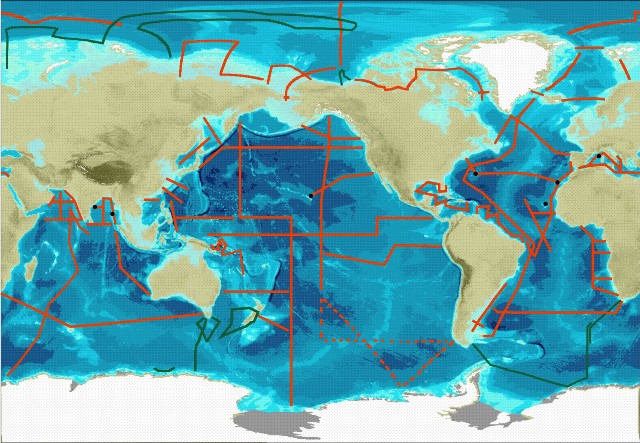
Three types of cruise are required to meet the goals set out by GEOTRACES. These are
- Section cruises - These will measure all the key parameters (see below) over the full depth of the water column. The sections were discussed and approved by the International GEOTRACES Scientific Steering Committee at the basin workshops.
- Process Studies - These will investigate a particular process relevant to the cycling of trace metal and isotopes. They must follow the "Criteria for Establishing GEOTRACES Process Studies" and be approved by the International GEOTRACES Scientific Steering Committee.
- Cruises collecting GEOTRACES compliant data - These will collect some trace element or isotope data. They must follow the GEOTRACES Intercalibration and Data Management protocols
IPY-GEOTRACES
The IPY-GEOTRACES programme comprised of 14 research cruises on ships from 7 nations; Australia, Canada, France, Germany, New Zealand, Japan and Russia. The cruises will not be classified in the same way as the full GEOTRACES programme since the intercalibration protocols and data management protocols had not been established before the start of the IPY. But IPY-GEOTRACES data will still be quality controlled by GDAC and in the majority of cases verified versus Intercalibration standards or protocols.
Key parameters
The key parameters as set out by the GEOTRACES science plan are as follows: Fe, Al, Zn, Mn, Cd, Cu; 15N, 13C; 230Th, 231Pa; Pb isotopes, Nd isotopes; stored sample, particles, aerosols.
Weblink:
http://www.bodc.ac.uk/geotraces/
http://www.geotraces.org/
Data Activity or Cruise Information
Cruise
| Cruise Name | SAG25 (AIMIZ-GIO6, GIpr07) |
| Departure Date | 2017-06-29 |
| Arrival Date | 2017-07-14 |
| Principal Scientist(s) | Marcello Vichi (University of Cape Town, Department of Oceanography) |
| Ship | S. A. Agulhas II |
Complete Cruise Metadata Report is available here
Fixed Station Information
No Fixed Station Information held for the Series
BODC Quality Control Flags
The following single character qualifying flags may be associated with one or more individual parameters with a data cycle:
| Flag | Description |
|---|---|
| Blank | Unqualified |
| < | Below detection limit |
| > | In excess of quoted value |
| A | Taxonomic flag for affinis (aff.) |
| B | Beginning of CTD Down/Up Cast |
| C | Taxonomic flag for confer (cf.) |
| D | Thermometric depth |
| E | End of CTD Down/Up Cast |
| G | Non-taxonomic biological characteristic uncertainty |
| H | Extrapolated value |
| I | Taxonomic flag for single species (sp.) |
| K | Improbable value - unknown quality control source |
| L | Improbable value - originator's quality control |
| M | Improbable value - BODC quality control |
| N | Null value |
| O | Improbable value - user quality control |
| P | Trace/calm |
| Q | Indeterminate |
| R | Replacement value |
| S | Estimated value |
| T | Interpolated value |
| U | Uncalibrated |
| W | Control value |
| X | Excessive difference |
SeaDataNet Quality Control Flags
The following single character qualifying flags may be associated with one or more individual parameters with a data cycle:
| Flag | Description |
|---|---|
| 0 | no quality control |
| 1 | good value |
| 2 | probably good value |
| 3 | probably bad value |
| 4 | bad value |
| 5 | changed value |
| 6 | value below detection |
| 7 | value in excess |
| 8 | interpolated value |
| 9 | missing value |
| A | value phenomenon uncertain |
| B | nominal value |
| Q | value below limit of quantification |