
Metadata Report for BODC Series Reference Number 2206748
Metadata Summary
Problem Reports
Data Access Policy
Narrative Documents
Project Information
Data Activity or Cruise Information
Fixed Station Information
BODC Quality Flags
SeaDataNet Quality Flags
Metadata Summary
Data Description |
|||||||||||||||||||||||||||||
|
|||||||||||||||||||||||||||||
Data Identifiers |
|||||||||||||||||||||||||||||
|
|||||||||||||||||||||||||||||
Time Co-ordinates(UT) |
|||||||||||||||||||||||||||||
|
|||||||||||||||||||||||||||||
Spatial Co-ordinates | |||||||||||||||||||||||||||||
|
|||||||||||||||||||||||||||||
Parameters |
|||||||||||||||||||||||||||||
|
|||||||||||||||||||||||||||||
|
|||||||||||||||||||||||||||||
Problem Reports
No Problem Report Found in the Database
Data Access Policy
Open Data
These data have no specific confidentiality restrictions for users. However, users must acknowledge data sources as it is not ethical to publish data without proper attribution. Any publication or other output resulting from usage of the data should include an acknowledgment.
If the Information Provider does not provide a specific attribution statement, or if you are using Information from several Information Providers and multiple attributions are not practical in your product or application, you may consider using the following:
"Contains public sector information licensed under the Open Government Licence v1.0."
Narrative Documents
Sea-Bird SBE 37 SMP {MicroCAT-CTP} (submersible) CTD logger
A high accuracy conductivity and temperature recorder with an integrated pressure sensor designed for deployment on moorings. The SM model uses a serial interface (SM) for real-time data transmissions and has internal batteries. The device is fitted with an integral pump (P).
For more information, please see this document: https://www.bodc.ac.uk/data/documents/nodb/pdf/SeaBird-datasheet-SBE37-SMP-July18.pdf
Originator's Processing of SeaBird SBE37 SMP-CTP MicroCAT Data: Darwin Mounds Mooring, DY120
Sampling strategy
The mooring was deployed by the RRS Discovery Cruise DY120 (23/10/2020). The SBE-37 SMP MicroCAT (Serial Number 8081) was attached to the wire of the single-point mooring in the Darwin sea Mounds (DMLTM) Marine Protected Area (MPA), at a nominal depth of around 1024 m.
Temperature, conductivity and pressure data were recorded every 30 minutes. Data were logged directly on the MicroCAT and downloaded once recovered.
Data processing
The mooring was recovered by the RRS James Cook JC238 on 27/07/2022. During recovery, the wire snapped. This lead to the loss of SeaBird SBE-37 SMP MicroCAT with serial number 8080.
Files were downloaded as native .cnv files and quality controlled and converted to .csv files. The processed data were supplied to BODC for banking.
Please see the DY120 cruise report for further detail of originators processing.
Processing by BODC of SeaBird SBE37 SMP-CTP MicroCAT data: Darwin Mounds Mooring, DY120
The Darwin sea Mounds (DMLTM) Marine Protected Area (MPA) mooring was deployed on 23/10/2020 by the RRS Discovery Cruise DY120. The rig was recovered by the RRS James Cook cruise JC238 on 27/07/2022. The data were collected from a nominal depth of 1024 m and supplied to BODC in .csv format. The data were then loaded into BODC's database using established BODC data banking procedures. For more information on the deployment of these instruments please see the DY120 cruise report.
During transfer to BODC internal format (QXF) the originator's variables were mapped to unique BODC parameter codes. The following table shows the parameter mapping:
| Originator's Variable | Originator's Units | BODC Parameter Code | BODC Units | Comment |
|---|---|---|---|---|
| Temperature [ITS-90, deg C] | deg C | TEMPP901 | Degrees Celsius | - |
| Conductivity [S/m] | S/m | CNDCPR01 | S/m | - |
| Pressure, Strain Gauge [db] | db | PREXMCAT | dbar | - |
The reformatted data were visualised using in-house EDSERPLO software. Any suspect data were flagged using the BODC quality control flags.
Project Information
Marine LTSS: CLASS (Climate Linked Atlantic Sector Science)
Introduction
CLASS is a five year (2018 to 2023) programme, funded by the Natural Environment Research Council (NERC) and extended until March 2024.
Scientific Rationale
The ocean plays a vital role in sustaining life on planet Earth, providing us with both living resources and climate regulation. The trajectory of anthropogenically driven climate change will be substantially controlled by the ocean due to its absorption of excess heat and carbon from the atmosphere, with consequent impacts on ocean resources that remain poorly understood. In an era of rapid planetary change, expanding global population and intense resource exploitation, it is vital that there are internationally coordinated ocean observing and prediction systems so policy makers can make sound evidence-based decisions about how to manage our interaction with the ocean. CLASS will underpin the UK contribution to these systems, documenting and understanding change in the marine environment, evaluating the impact of climate change and effectiveness of conservation measures and predicting the future evolution of marine environments. Over the five-year period CLASS will enhance the cost-effectiveness of observing systems by migrating them towards cutting edge autonomous technologies and developing new sensors. Finally, CLASS will create effective engagement activities ensuring academic partners have transparent access to NERC marine science capability through graduate training partnerships and access to shipborne, lab based and autonomous facilities, and modelling capabilities.
Data Activity or Cruise Information
Data Activity
| Start Date (yyyy-mm-dd) | 2020-10-23 |
| End Date (yyyy-mm-dd) | 2022-07-27 |
| Organization Undertaking Activity | National Oceanography Centre, Southampton |
| Country of Organization | United Kingdom |
| Originator's Data Activity Identifier | DMLTM_102020 |
| Platform Category | subsurface mooring |
Darwin Mounds Long-Term Mooring - October 2020
This rig was deployed as a contribution to the Climate Linked Atlantic Section Science (CLASS) project's sustained observations and marine protected area studies, supported by the UK Natural Environment Research Council. 'DMLTM_102020' refers to the deployment of the Darwin Sea Mounds (DMLTM) mooring in October 2020 ('102020'), located North-west of Cape Wrath, Scotland. Further details of the deployment can be found in the DY120 cruise report.
Data summary
| Deployment cruise | RRS Discovery DY120 |
| Recovery cruise | RRS James Cook JC238 |
| Rig position | 59.86° N; -7.04° E |
| Water depth | 1036 m |
| Deployed | 23rd October 2020 |
| Recovered | 27th July 2022 |
Instrumentation
The Darwin Mounds long-term mooring, deployed on DY120, was anchored by a 1000 kg chain clump anchor and kept buoyant with 3 glass spheres. This mooring was subsurface.
| Instrument | Serial number | Nominal depth | Comments |
| SeaBird SBE37 SMP-CTP MicroCAT | s/n 8080 | 949 m | During recovery the wire snapped and this instrument was lost. |
| Teledyne TRDI Workhorse Sentinel 600 kHz ADCP | s/n 22790 | 998 m | - |
| McLane Parflux 78H-21 Sediment Trap | s/n 12168-03 | 1014 m | - |
| SeaBird SBE37 SMP-CTP MicroCAT | s/n 8081 | 1024 m | - |
Related Data Activity activities are detailed in Appendix 1
Cruise
| Cruise Name | DY120 |
| Departure Date | 2020-10-08 |
| Arrival Date | 2020-10-24 |
| Principal Scientist(s) | Stuart A Cunningham (Scottish Association for Marine Science) |
| Ship | RRS Discovery |
Complete Cruise Metadata Report is available here
Fixed Station Information
Fixed Station Information
| Station Name | Darwin Mounds Marine Protected Area, Special Area of Conservation |
| Category | Offshore area |
| Latitude | 59° 45.50' N |
| Longitude | 7° 13.00' W |
| Water depth below MSL | 1130.0 m |
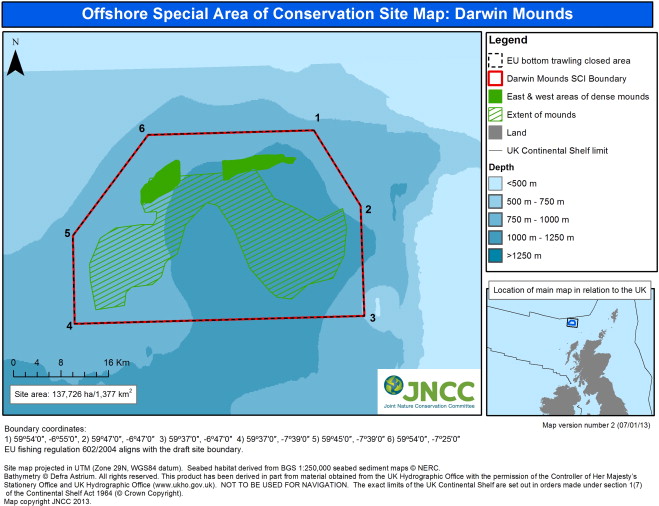
Fixed Station - Darwin Mounds Marine Protected Area (MPA) Special Area of Conservation (SAC)
The Darwin Mounds are located approximately 160 km north-west of Cape Wrath, Scotland, at the north end of the Rockall Trough. The site was designated a Marine Protected Area (MPA) in June 2002 and was formally assigned a Special Area of Conservation (SAC) from March 2018. The site area is approximately 1377 km2 and the water depth ranges from 710 - 1129 m. The site consists of a large number of coral-topped 'sand volcanoes' composed of sand overlying mud. The individual mounds are up to 75 m wide and 5 m high and are morphologically unique in UK waters. The mounds themselves are unusual geological features that are thought to have been formed by fluid expulsion from the seabed. The mounds are most elevated to the north of the site and diminish in height to the south. There are two denser regions of mounds in the north-east and north-west of the site. The north-east field of the Darwin Mounds measures approximately 13 km by 9 km and contains approximately 150 mounds, whereas the north-west field measures approximately 13 km by 4 km and contains approximately 75 mounds.
The mounds in the northern part of the site show an acoustic signature of a 'tail' which generally lies to the south-west of the mound feature consisting of elongate to oval patches up to 500 m long. The 'tail' feature of the mounds is thought to be unique globally. The tails are not topographically distinct from the surrounding seabed but are covered with a fine veneer of sand. They support substantial numbers of the xenophyophore Syringammina fragilissima (a single-celled organism that can grow up to 20 cm in diameter), in densities greater than the surrounding seabed.
On the majority of the mounds there are also multiple colonies of Lophelia pertusa growing, which in many cases have formed thickets which arise from the surface of the mound. This site was the first observed record of cold-water coral reefs growing on sand at the time of discovery. Like the topography of the mounds, the frequency of coral communities diminishes towards the south of the mound field. Although the reef habitat on top of the mounds is formed primarily from Lophelia pertusa, another cold-water coral Madrepora oculata is also present. The thickets of cold-water corals provide a habitat for echiuran worms, brittlestars, brisingiid starfish and sponges. Various fish have been observed among the mounds, but not at higher densities than the wider environment.
For further information see the JNCC website. Image available to download here.
Sampling History
| D248 (2000) | CD123 (2000) | JC060 (2011) | JC136 (2016) | DY108(109) (2019) | DY120 (2020) | |
|---|---|---|---|---|---|---|
| ROV video/photography | N | N | Y | Y | Y | N |
| AUV video/photography | N | N | Y | Y | Y | N |
| Bathysnap video/photography | Y | Y | N | N | N | N |
| WASP video/photography | N | Y | N | N | N | N |
| SHRIMP video/photography | Y | N | N | N | N | N |
| Shipboard Multibeam Bathymetry | N | N | Y | Y | Y | Y |
| AUV Multibeam Bathymetry | N | N | Y | Y | Y | N |
| AUV Sidescan Sonar | N | N | Y | N | Y | N |
| TOBI Sidescan Sonar | Y | N | N | N | N | N |
| CTD casts | Y | N | Y | Y | Y | Y |
| SAPS | Y | N | N | N | N | N |
| Megacorer | Y | Y | Y | N | Y | N |
| Box corer | Y | Y | Y | N | Y | N |
| Piston corer | Y | N | N | N | N | N |
| Gravity corer | N | Y | N | N | N | N |
| Moored ADCP | Y | N | N | Y | Y | Y |
| Moored sediment trap | N | N | N | N | Y | Y |
| Moored SBE37 MicroCAT | N | N | N | N | Y | Y |
Related Fixed Station activities are detailed in Appendix 2
BODC Quality Control Flags
The following single character qualifying flags may be associated with one or more individual parameters with a data cycle:
| Flag | Description |
|---|---|
| Blank | Unqualified |
| < | Below detection limit |
| > | In excess of quoted value |
| A | Taxonomic flag for affinis (aff.) |
| B | Beginning of CTD Down/Up Cast |
| C | Taxonomic flag for confer (cf.) |
| D | Thermometric depth |
| E | End of CTD Down/Up Cast |
| G | Non-taxonomic biological characteristic uncertainty |
| H | Extrapolated value |
| I | Taxonomic flag for single species (sp.) |
| K | Improbable value - unknown quality control source |
| L | Improbable value - originator's quality control |
| M | Improbable value - BODC quality control |
| N | Null value |
| O | Improbable value - user quality control |
| P | Trace/calm |
| Q | Indeterminate |
| R | Replacement value |
| S | Estimated value |
| T | Interpolated value |
| U | Uncalibrated |
| W | Control value |
| X | Excessive difference |
SeaDataNet Quality Control Flags
The following single character qualifying flags may be associated with one or more individual parameters with a data cycle:
| Flag | Description |
|---|---|
| 0 | no quality control |
| 1 | good value |
| 2 | probably good value |
| 3 | probably bad value |
| 4 | bad value |
| 5 | changed value |
| 6 | value below detection |
| 7 | value in excess |
| 8 | interpolated value |
| 9 | missing value |
| A | value phenomenon uncertain |
| B | nominal value |
| Q | value below limit of quantification |
Appendix 1: DMLTM_102020
Related series for this Data Activity are presented in the table below. Further information can be found by following the appropriate links.
If you are interested in these series, please be aware we offer a multiple file download service. Should your credentials be insufficient for automatic download, the service also offers a referral to our Enquiries Officer who may be able to negotiate access.
| Series Identifier | Data Category | Start date/time | Start position | Cruise |
|---|---|---|---|---|
| 2228824 | Currents -subsurface Eulerian | 2020-10-23 09:39:00 | 59.8613 N, 7.04434 W | RRS Discovery DY120 |
| 2228836 | Currents -subsurface Eulerian | 2021-01-01 00:00:00 | 59.8613 N, 7.04434 W | RRS Discovery DY120 |
| 2228848 | Currents -subsurface Eulerian | 2022-01-01 00:00:00 | 59.8613 N, 7.04434 W | RRS Discovery DY120 |
Appendix 2: Darwin Mounds Marine Protected Area, Special Area of Conservation
Related series for this Fixed Station are presented in the table below. Further information can be found by following the appropriate links.
If you are interested in these series, please be aware we offer a multiple file download service. Should your credentials be insufficient for automatic download, the service also offers a referral to our Enquiries Officer who may be able to negotiate access.
| Series Identifier | Data Category | Start date/time | Start position | Cruise |
|---|---|---|---|---|
| 2027806 | Bathymetry | 2019-09-21 03:29:10 | 59.09489 N, 8.00387 W | RRS Discovery DY108 (DY109) |
| 2201209 | Hydrography time series at depth | 2019-09-23 08:15:55 | 59.8637 N, 7.05 W | RRS Discovery DY108 (DY109) |
| 2201210 | Hydrography time series at depth | 2019-09-23 08:17:48 | 59.8637 N, 7.05 W | RRS Discovery DY108 (DY109) |
| 2228824 | Currents -subsurface Eulerian | 2020-10-23 09:39:00 | 59.8613 N, 7.04434 W | RRS Discovery DY120 |
| 2228836 | Currents -subsurface Eulerian | 2021-01-01 00:00:00 | 59.8613 N, 7.04434 W | RRS Discovery DY120 |
| 2228848 | Currents -subsurface Eulerian | 2022-01-01 00:00:00 | 59.8613 N, 7.04434 W | RRS Discovery DY120 |