
Metadata Report for BODC Series Reference Number 2243704
Metadata Summary
Problem Reports
Data Access Policy
Narrative Documents
Project Information
Data Activity or Cruise Information
Fixed Station Information
BODC Quality Flags
SeaDataNet Quality Flags
Metadata Summary
Data Description |
|||||||||||||||||||||||||||||||||||||||||||||
|
|||||||||||||||||||||||||||||||||||||||||||||
Data Identifiers |
|||||||||||||||||||||||||||||||||||||||||||||
|
|||||||||||||||||||||||||||||||||||||||||||||
Time Co-ordinates(UT) |
|||||||||||||||||||||||||||||||||||||||||||||
|
|||||||||||||||||||||||||||||||||||||||||||||
Spatial Co-ordinates | |||||||||||||||||||||||||||||||||||||||||||||
|
|||||||||||||||||||||||||||||||||||||||||||||
Parameters |
|||||||||||||||||||||||||||||||||||||||||||||
|
|||||||||||||||||||||||||||||||||||||||||||||
Definition of BOTTFLAG | |||||||||||||||||||||||||||||||||||||||||||||
| BOTTFLAG | Definition |
|---|---|
| 0 | The sampling event occurred without any incident being reported to BODC. |
| 1 | The filter in an in-situ sampling pump physically ruptured during sample resulting in an unquantifiable loss of sampled material. |
| 2 | Analytical evidence (e.g. surface water salinity measured on a sample collected at depth) indicates that the water sample has been contaminated by water from depths other than the depths of sampling. |
| 3 | The feedback indicator on the deck unit reported that the bottle closure command had failed. General Oceanics deck units used on NERC vessels in the 80s and 90s were renowned for reporting misfires when the bottle had been closed. This flag is also suitable for when a trigger command is mistakenly sent to a bottle that has previously been fired. |
| 4 | During the sampling deployment the bottle was fired in an order other than incrementing rosette position. Indicative of the potential for errors in the assignment of bottle firing depth, especially with General Oceanics rosettes. |
| 5 | Water was reported to be escaping from the bottle as the rosette was being recovered. |
| 6 | The bottle seals were observed to be incorrectly seated and the bottle was only part full of water on recovery. |
| 7 | Either the bottle was found to contain no sample on recovery or there was no bottle fitted to the rosette position fired (but SBE35 record may exist). |
| 8 | There is reason to doubt the accuracy of the sampling depth associated with the sample. |
| 9 | The bottle air vent had not been closed prior to deployment giving rise to a risk of sample contamination through leakage. |
Definition of Rank |
|
|
Problem Reports
No Problem Report Found in the Database
Data Access Policy
Open Data
These data have no specific confidentiality restrictions for users. However, users must acknowledge data sources as it is not ethical to publish data without proper attribution. Any publication or other output resulting from usage of the data should include an acknowledgment.
If the Information Provider does not provide a specific attribution statement, or if you are using Information from several Information Providers and multiple attributions are not practical in your product or application, you may consider using the following:
"Contains public sector information licensed under the Open Government Licence v1.0."
Narrative Documents
Seal Analytical AutoAnalyzer 3HR
The model AA3 is an upgrade from Seal Analytics AutoAnalyzer II and is specifically designed for colorimetric determination of dissolved nutrients in environmental smaples. This model fully automates repetitive and complex sample analysis and can perform solvent extractions, distillation, gas diffusion, on-line filtration and in-line UV digestion in a continuously flowing stream.
It has a modular design which can integrate a sampler, pump, chemistry test module and photometer. It also accepts Multitest Manifolds designed to extend any size analyzer to a multiple chemistry system capable of dual range of tests which, in turn, eliminate the need to change manifolds and filters when changing tests.
The AA3 uses segmented flow analysis principles to reduce inter-sample dispersion, it can analyse up to 100 samples per hour using stable LED light sources. It also contains glass coils, which allow for chemically inert and easy visual checks.
The available modules are:
- Digital colorimeter: bubble through the flow cell to increase sampling rate and true Dual beam operation with continuous real-time referencing
- High Precision Pump: multi-speed motor, electronic air injection, optional valves for auto reagent switching and a buil in leak detector
- Multitest Manifold: allows for up to 16 different analyses
- Chemistry Module: glass coils which are chemically inter and allow for clear view of the flow, gas difusion or dialysis options
- XY2/XY3: high capacity random access sampler, up to 180/270 samples in cups or tubes in 2/3 racks, separate rack for standards, optional integrated pump and auto-diluter
- Distillation Module: automatic in line distillation when required before colorimetric analysis
Further information can be found in the manufacturer's brochure.
Niskin Bottle
The Niskin bottle is a device used by oceanographers to collect subsurface seawater samples. It is a plastic bottle with caps and rubber seals at each end and is deployed with the caps held open, allowing free-flushing of the bottle as it moves through the water column.
Standard Niskin
The standard version of the bottle includes a plastic-coated metal spring or elastic cord running through the interior of the bottle that joins the two caps, and the caps are held open against the spring by plastic lanyards. When the bottle reaches the desired depth the lanyards are released by a pressure-actuated switch, command signal or messenger weight and the caps are forced shut and sealed, trapping the seawater sample.
Lever Action Niskin
The Lever Action Niskin Bottle differs from the standard version, in that the caps are held open during deployment by externally mounted stainless steel springs rather than an internal spring or cord. Lever Action Niskins are recommended for applications where a completely clear sample chamber is critical or for use in deep cold water.
Clean Sampling
A modified version of the standard Niskin bottle has been developed for clean sampling. This is teflon-coated and uses a latex cord to close the caps rather than a metal spring. The clean version of the Levered Action Niskin bottle is also teflon-coated and uses epoxy covered springs in place of the stainless steel springs. These bottles are specifically designed to minimise metal contamination when sampling trace metals.
Deployment
Bottles may be deployed singly clamped to a wire or in groups of up to 48 on a rosette. Standard bottles and Lever Action bottles have a capacity between 1.7 and 30 L. Reversing thermometers may be attached to a spring-loaded disk that rotates through 180° on bottle closure.
CTD nutrients data for Cruise JC247
Originator's Protocol for Data Acquisition and Analysis
Sampling methodology
Water column depth profile samples were taken from a stainless steel CTD (conductivity, temperature and depth) rosette during the RRS James Cook Cruise JC247. The CTD rosette was fitted with a standard steel cable and 20L OTE (Ocean Test Equipment) Niskin bottles. Acid clean 60ml HDPE (high-density polyethylene) Nalgene bottles were used for all the nutrient sampling. These were aged, acid washed and cleaned initially, and stored with a 10% acid solution between sampling. The sample bottle and cap were washed 3 times before taking the final sample, and capped tightly. The samples were stored in the dark at 4°C until analysis, which was as soon as practical. Nutrient free (Semperguard) gloves were used and other clean handling protocols were adopted as close to those according to the GO-SHIP nutrient manual protocols (Becker et al, 2020).
Analytical methodology
The PML (Plymouth Marine Laboratory) 5-channel (nitrate, nitrite, phosphate, ammonium and silicate) SEAL analytical AAIII system with high-resolution colorimeters was used for analysis. This is a micro-molar segmented flow colorimetric auto-analyser with classical proven analytical techniques. The analytical chemical methodologies used were according to Brewer and Riley (1965) for nitrate, Grasshoff (1976) for nitrite, Mantoura and Woodward (1983) for ammonium, and Kirkwood (1989) for silicate and phosphate.
The instrument was calibrated with calibrated home produced nutrient stock standards. Daily quality control samples were analysed using Nutrient Reference Materials from SCOR / Jamstec and KANSO Technos, Japan. Batches CH and BU were used during the cruise. The nutrients were all within an accuracy of 2 - 3%.
References Cited
Becker S., Aoyama M., Woodward E.M.S., Malcolm S., Bakker K., Coverly S., Mahaffey C. and Tanhua T., 2020. GO-SHIP Repeat Hydrography Nutrient Manual: The precise and accurate determination of dissolved inorganic nutrients in seawater, using continuous flow analysis methods. Frontiers in Marine Science 7, 2296-7745. doi: 10.3389/fmars.2020.581790.
Brewer P.G. and Riley J.P., 1965. The automatic determination of nitrate in seawater. Deep Sea Research, 12, 765-72.
Grasshoff K., 1976. Methods of seawater analysis. Verlag Chemie, Weinheim and New York, 317pp.
Mantoura R.F.C and Woodward E.M.S, 1983. Optimization of the indophenol blue method for the automated determination of ammonia in estuarine waters. Estuarine Coastal and Shelf Science 17(2), 219-224. https://doi.org/10.1016/0272-7714(83)90067-7
Kirkwood D., 1989. Simultaneous determination of selected nutrients in seawater. ICES CM 1989/C:29.
JC247 Cruise report
Further information can be found in the JC247 Cruise report.
BODC Data Processing Procedures
Data received were loaded into the BODC database using established BODC data banking procedures. A parameter mapping table is provided below:
| Originator's Variable | Originator's Units | BODC Parameter Code | BODC Unit | Comments |
|---|---|---|---|---|
| Nitrite(µM) | µM | NTRIAATX | umol/l | - |
| Nitrate+Nit(µM) | µM | NTRZAATX | umol/l | - |
| Ammonium(µM) | µM | AMONAATX | umol/l | - |
| Silicate(µM) | µM | SLCAAATX | umol/l | - |
| Phosphate(µM) | µM | PHOSAATX | umol/l | - |
Data Quality Report
The limit of detection for AMONAATX was 0.03 umol/l. Values below this limit have been flagged '<' by BODC.
Null values were flagged as 'NA' or 'N/A' by the originator. These have been flagged 'N' by BODC.
Project Information
Marine LTSS: CLASS (Climate Linked Atlantic Sector Science)
Introduction
CLASS is a five year (2018 to 2023) programme, funded by the Natural Environment Research Council (NERC) and extended until March 2024.
Scientific Rationale
The ocean plays a vital role in sustaining life on planet Earth, providing us with both living resources and climate regulation. The trajectory of anthropogenically driven climate change will be substantially controlled by the ocean due to its absorption of excess heat and carbon from the atmosphere, with consequent impacts on ocean resources that remain poorly understood. In an era of rapid planetary change, expanding global population and intense resource exploitation, it is vital that there are internationally coordinated ocean observing and prediction systems so policy makers can make sound evidence-based decisions about how to manage our interaction with the ocean. CLASS will underpin the UK contribution to these systems, documenting and understanding change in the marine environment, evaluating the impact of climate change and effectiveness of conservation measures and predicting the future evolution of marine environments. Over the five-year period CLASS will enhance the cost-effectiveness of observing systems by migrating them towards cutting edge autonomous technologies and developing new sensors. Finally, CLASS will create effective engagement activities ensuring academic partners have transparent access to NERC marine science capability through graduate training partnerships and access to shipborne, lab based and autonomous facilities, and modelling capabilities.
Data Activity or Cruise Information
Data Activity
| Start Date (yyyy-mm-dd) | 2023-05-07 |
| End Date (yyyy-mm-dd) | 2023-05-07 |
| Organization Undertaking Activity | National Oceanography Centre, Southampton |
| Country of Organization | United Kingdom |
| Originator's Data Activity Identifier | JC247_CTD_CTD2 |
| Platform Category | lowered unmanned submersible |
BODC Sample Metadata Report for JC247_CTD_CTD2
| Sample reference number | Nominal collection volume(l) | Bottle rosette position | Bottle firing sequence number | Minimum pressure sampled (dbar) | Maximum pressure sampled (dbar) | Depth of sampling point (m) | Bottle type | Sample quality flag | Bottle reference | Comments |
|---|---|---|---|---|---|---|---|---|---|---|
| 2016761 | 1 | 1 | 1699.40 | 1700.00 | 1678.60 | Niskin bottle | No problem reported | 500 | ||
| 2016764 | 2 | 2 | 1699.20 | 1700.20 | 1678.50 | Niskin bottle | No problem reported | |||
| 2016767 | 3 | 3 | 1699.20 | 1700.30 | 1678.50 | Niskin bottle | No problem reported | |||
| 2016770 | 4 | 4 | 1219.30 | 1219.80 | 1205.70 | Niskin bottle | No problem reported | 501 | ||
| 2016773 | 5 | 5 | 1219.30 | 1220.10 | 1205.90 | Niskin bottle | No problem reported | |||
| 2016776 | 6 | 6 | 1219.10 | 1220.10 | 1205.80 | Niskin bottle | No problem reported | |||
| 2016779 | 7 | 7 | 813.40 | 813.90 | 805.10 | Niskin bottle | No problem reported | 502 | ||
| 2016782 | 8 | 8 | 813.60 | 814.30 | 805.50 | Niskin bottle | No problem reported | |||
| 2016785 | 9 | 9 | 813.30 | 814.60 | 805.50 | Niskin bottle | No problem reported | |||
| 2016788 | 10 | 10 | 355.70 | 356.60 | 352.90 | Niskin bottle | No problem reported | |||
| 2016791 | 11 | 11 | 355.60 | 356.40 | 352.80 | Niskin bottle | No problem reported | |||
| 2016794 | 12 | 12 | 355.70 | 356.60 | 353.00 | Niskin bottle | No problem reported | |||
| 2016797 | 13 | 13 | 203.10 | 204.70 | 202.00 | Niskin bottle | No problem reported | 503 | ||
| 2016800 | 14 | 14 | 203.60 | 204.80 | 202.40 | Niskin bottle | No problem reported | |||
| 2016803 | 15 | 15 | 203.40 | 204.20 | 202.00 | Niskin bottle | No problem reported | |||
| 2016806 | 16 | 16 | 57.30 | 58.10 | 57.20 | Niskin bottle | No problem reported | 504 | ||
| 2016809 | 17 | 17 | 57.50 | 58.20 | 57.40 | Niskin bottle | Bottle leak | Leak/misfire mentioned in cruise report | ||
| 2016812 | 18 | 18 | 57.10 | 58.40 | 57.30 | Niskin bottle | No problem reported | |||
| 2016815 | 19 | 19 | 27.20 | 27.90 | 27.40 | Niskin bottle | No problem reported | 505 | ||
| 2016818 | 20 | 20 | 26.90 | 27.90 | 27.10 | Niskin bottle | No problem reported | |||
| 2016821 | 21 | 21 | 27.20 | 27.70 | 27.20 | Niskin bottle | No problem reported | |||
| 2016824 | 22 | 22 | 6.80 | 8.00 | 7.40 | Niskin bottle | No problem reported | 506 | ||
| 2016827 | 23 | 23 | 6.80 | 8.00 | 7.40 | Niskin bottle | No problem reported | |||
| 2016830 | 24 | 24 | 7.10 | 7.80 | 7.40 | Niskin bottle | No problem reported |
Please note:the supplied parameters may not have been sampled from all the bottle firings described in the table above. Cross-match the Sample Reference Number above against the SAMPRFNM value in the data file to identify the relevant metadata.
Cruise
| Cruise Name | JC247 |
| Departure Date | 2023-05-05 |
| Arrival Date | 2023-05-22 |
| Principal Scientist(s) | Andrew R Gates (National Oceanography Centre, Southampton) |
| Ship | RRS James Cook |
Complete Cruise Metadata Report is available here
Fixed Station Information
Fixed Station Information
| Station Name | Whittard Canyon - The Canyons Marine Conservation Zone |
| Category | Offshore area |
| Latitude | 48° 6.00' N |
| Longitude | 10° 18.00' W |
| Water depth below MSL | 3600.0 m |
Fixed Station - Whittard Canyon - The Canyons Marine Conservation Zone
The Canyons MCZ is located in the far south-west corner of the UK continental shelf, more than 330 km from Land's End, Cornwall. It encompasses the steep part of the shelf break where the seabed drops from a depth of 100 m to the oceanic abyssal plain at 2000 m. It is unique within the context of England's largely shallow seas due to its depth, sea-bed topography and the coral features it contains.
There are two large canyons within the site, which add to its topographic complexity: the Explorer Canyon to the north and the Dangaard Canyon below it. The wider Whittard Canyon area encapsulates the Canyons MCZ and also includes a network of submarine canyons to the West. The MCZ, also known as a Marine Protected Area (MPA), was designated in November 2013 under the Marine and Coastal Access Act (2009). The Canyons MCZ covers an area of 661 km2, which extends to approximately 5200 km2 when Whittard Canyon is included.
On the northernmost wall of the Explorer Canyon is a patch of live Cold-water coral reef (Lophelia pertusa) and Coral gardens, both of which are a OSPAR threatened and/or declining habitat. This is the only known example of living Cold-water coral reef recorded within England's seas, making it unique in these waters.
Cold-water corals and Coral gardens typically support a range of other organisms. The coral provides a three-dimensional structure and a variety of microhabitats that provide shelter and an attachment surface for other species. Both Cold-water corals and Coral gardens can be long-lived but are extremely slow growing (at about 6 mm a year), making protection important for their conservation. Another reef-forming cold-water coral, Madrepora oculata, is also present in the site.
The variety of deep-sea bed communities present are indicative of the range of substrates found in and around the canyons, including bedrock, biogenic reef, coral rubble, coarse sediment, mud and sand. These biological communities include cold-water coral communities (Lophelia pertusa and Madrepora oculata), Coral gardens, feather star (Leptometra celtica) assemblages and Sea-pen and burrowing megafauna communities (including, burrowing anemone fields, squat lobster (Munida sp.) assemblages, barnacle assemblages and deep-sea sea-pen (Kophobelemnon sp.) fields).
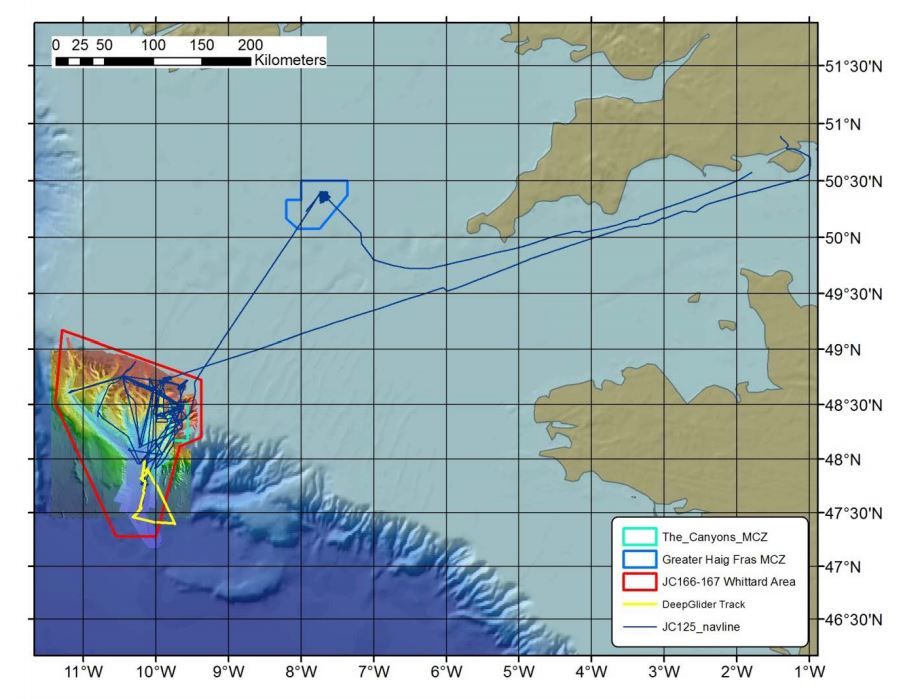
Sampling History
| JC035 (2009) | JC125 (2015) | JC166/7 (2018) | |
|---|---|---|---|
| ROV video/photography | Y | Y | Y |
| AUV video/photography | N | Y | Y |
| Shipboard Multibeam Bathymetry | Y | Y | Y |
| AUV Multibeam Bathymetry | N | Y | Y |
| AUV Sidescan Sonar | N | Y | Y |
| TOBI Sidescan Sonar | Y | Y | Y |
| ROV vibrocorer | N | Y | N |
| CTD casts | N | Y | N |
| SAPS | N | Y | N |
Related Fixed Station activities are detailed in Appendix 1
BODC Quality Control Flags
The following single character qualifying flags may be associated with one or more individual parameters with a data cycle:
| Flag | Description |
|---|---|
| Blank | Unqualified |
| < | Below detection limit |
| > | In excess of quoted value |
| A | Taxonomic flag for affinis (aff.) |
| B | Beginning of CTD Down/Up Cast |
| C | Taxonomic flag for confer (cf.) |
| D | Thermometric depth |
| E | End of CTD Down/Up Cast |
| G | Non-taxonomic biological characteristic uncertainty |
| H | Extrapolated value |
| I | Taxonomic flag for single species (sp.) |
| K | Improbable value - unknown quality control source |
| L | Improbable value - originator's quality control |
| M | Improbable value - BODC quality control |
| N | Null value |
| O | Improbable value - user quality control |
| P | Trace/calm |
| Q | Indeterminate |
| R | Replacement value |
| S | Estimated value |
| T | Interpolated value |
| U | Uncalibrated |
| W | Control value |
| X | Excessive difference |
SeaDataNet Quality Control Flags
The following single character qualifying flags may be associated with one or more individual parameters with a data cycle:
| Flag | Description |
|---|---|
| 0 | no quality control |
| 1 | good value |
| 2 | probably good value |
| 3 | probably bad value |
| 4 | bad value |
| 5 | changed value |
| 6 | value below detection |
| 7 | value in excess |
| 8 | interpolated value |
| 9 | missing value |
| A | value phenomenon uncertain |
| B | nominal value |
| Q | value below limit of quantification |
Appendix 1: Whittard Canyon - The Canyons Marine Conservation Zone
Related series for this Fixed Station are presented in the table below. Further information can be found by following the appropriate links.
If you are interested in these series, please be aware we offer a multiple file download service. Should your credentials be insufficient for automatic download, the service also offers a referral to our Enquiries Officer who may be able to negotiate access.
| Series Identifier | Data Category | Start date/time | Start position | Cruise |
|---|---|---|---|---|
| 2026920 | Bathymetry | 2009-06-09 00:00:00 | 47.1792 N, 11.2483 W | RRS James Cook JC035 |
| 2026932 | Bathymetry | 2009-06-09 00:00:00 | 48.4273 N, 11.2343 W | RRS James Cook JC035 |
| 2202723 | CTD or STD cast | 2009-06-22 14:25:05 | 48.15317 N, 10.53967 W | RRS James Cook JC036 |
| 2202735 | CTD or STD cast | 2009-07-09 18:58:19 | 48.81283 N, 11.15917 W | RRS James Cook JC036 |
| 2202747 | CTD or STD cast | 2009-07-10 23:22:15 | 48.2835 N, 10.314 W | RRS James Cook JC036 |
| 2202759 | CTD or STD cast | 2009-07-12 00:52:48 | 48.26533 N, 10.182 W | RRS James Cook JC036 |
| 2202760 | CTD or STD cast | 2009-07-18 05:48:17 | 48.60333 N, 9.9665 W | RRS James Cook JC036 |
| 2202772 | CTD or STD cast | 2009-07-26 03:59:18 | 48.653 N, 10.033 W | RRS James Cook JC036 |
| 2202803 | CTD or STD cast | 2015-08-13 21:32:12 | 47.9595 N, 10.217 W | RRS James Cook JC125 (JC124, JC126) |
| 2027020 | Bathymetry | 2015-08-14 01:23:00 | 47.5404 N, 11.2236 W | RRS James Cook JC125 (JC124, JC126) |
| 2027032 | Bathymetry | 2015-08-15 02:05:00 | 48.4621 N, 9.9608 W | RRS James Cook JC125 (JC124, JC126) |
| 2202815 | CTD or STD cast | 2015-08-15 15:56:36 | 48.38949 N, 9.99615 W | RRS James Cook JC125 (JC124, JC126) |
| 2202827 | CTD or STD cast | 2015-08-16 17:12:56 | 48.65512 N, 10.03444 W | RRS James Cook JC125 (JC124, JC126) |
| 2202839 | CTD or STD cast | 2015-08-20 03:56:28 | 48.65348 N, 10.03337 W | RRS James Cook JC125 (JC124, JC126) |
| 2202840 | CTD or STD cast | 2015-08-20 10:30:09 | 48.76099 N, 10.4609 W | RRS James Cook JC125 (JC124, JC126) |
| 2202852 | CTD or STD cast | 2015-08-25 10:31:46 | 48.46176 N, 9.63347 W | RRS James Cook JC125 (JC124, JC126) |
| 2202864 | CTD or STD cast | 2015-08-25 12:17:30 | 48.46583 N, 9.63871 W | RRS James Cook JC125 (JC124, JC126) |
| 2202876 | CTD or STD cast | 2015-08-25 13:59:18 | 48.4682 N, 9.64339 W | RRS James Cook JC125 (JC124, JC126) |
| 2202888 | CTD or STD cast | 2015-08-26 10:01:43 | 48.47488 N, 9.6532 W | RRS James Cook JC125 (JC124, JC126) |
| 2202907 | CTD or STD cast | 2015-08-26 13:34:15 | 48.46164 N, 9.63353 W | RRS James Cook JC125 (JC124, JC126) |
| 2202919 | CTD or STD cast | 2015-08-26 15:00:47 | 48.46574 N, 9.63858 W | RRS James Cook JC125 (JC124, JC126) |
| 2202920 | CTD or STD cast | 2015-08-26 18:36:18 | 48.46819 N, 9.64337 W | RRS James Cook JC125 (JC124, JC126) |
| 2202932 | CTD or STD cast | 2015-08-26 20:04:18 | 48.47199 N, 9.64881 W | RRS James Cook JC125 (JC124, JC126) |
| 2202944 | CTD or STD cast | 2015-08-26 21:54:21 | 48.48103 N, 9.6606 W | RRS James Cook JC125 (JC124, JC126) |
| 2202956 | CTD or STD cast | 2015-08-26 23:32:10 | 48.49106 N, 9.67511 W | RRS James Cook JC125 (JC124, JC126) |
| 2202968 | CTD or STD cast | 2015-09-01 08:36:10 | 48.47488 N, 9.65322 W | RRS James Cook JC125 (JC124, JC126) |
| 2202981 | CTD or STD cast | 2015-09-06 02:27:13 | 48.65368 N, 10.03353 W | RRS James Cook JC125 (JC124, JC126) |
| 2202993 | CTD or STD cast | 2015-09-06 12:37:15 | 48.48615 N, 10.04908 W | RRS James Cook JC125 (JC124, JC126) |
| 2026993 | Bathymetry | 2018-06-23 23:02:00 | 47.4704 N, 10.586 W | RRS James Cook JC166 (JC167) |
| 2027007 | Bathymetry | 2018-06-24 19:43:00 | 48.2761 N, 9.8577 W | RRS James Cook JC166 (JC167) |
| 2205929 | Hydrography time series at depth | 2019-07-08 06:25:09 | 48.62615 N, 10.00373 W | RRS Discovery DY103 |
| 2222318 | Currents -subsurface Eulerian | 2019-07-08 06:55:00 | 48.62615 N, 10.00373 W | RRS Discovery DY103 |
| 2222306 | Currents -subsurface Eulerian | 2019-07-08 07:00:00 | 48.62615 N, 10.00373 W | RRS Discovery DY103 |
| 2205917 | Hydrography time series at depth | 2019-07-08 07:12:21 | 48.62615 N, 10.00373 W | RRS Discovery DY103 |
| 2222343 | Currents -subsurface Eulerian | 2020-11-13 12:18:00 | 48.626 N, 10.004 W | RRS Discovery DY116 |
| 2222331 | Currents -subsurface Eulerian | 2020-11-13 12:30:00 | 48.626 N, 10.004 W | RRS Discovery DY116 |
| 2205930 | Hydrography time series at depth | 2020-11-13 13:00:01 | 48.3756 N, 10.024 W | RRS Discovery DY116 |
| 2205942 | Hydrography time series at depth | 2020-11-13 13:00:01 | 48.3756 N, 10.024 W | RRS Discovery DY116 |
| 2222367 | Currents -subsurface Eulerian | 2021-03-29 12:09:02 | 48.626 N, 9.996 W | RRS Discovery DY130 |
| 2206761 | Hydrography time series at depth | 2021-03-29 12:10:33 | 48.626 N, 9.996 W | RRS Discovery DY130 |
| 2206773 | Hydrography time series at depth | 2021-03-29 12:13:06 | 48.626 N, 9.996 W | RRS Discovery DY130 |
| 2222355 | Currents -subsurface Eulerian | 2021-03-29 12:24:51 | 48.626 N, 9.996 W | RRS Discovery DY130 |
| 2222379 | Currents -subsurface Eulerian | 2022-01-01 00:25:32 | 48.626 N, 9.996 W | RRS Discovery DY130 |
| 2225469 | Bathymetry | 2022-07-10 00:00:00 | 47.8623 N, 10.8343 W | RRS Discovery DY152 |
| 2225494 | Bathymetry | 2022-08-06 00:00:00 | 48.1325 N, 10.6492 W | RRS James Cook JC237 |
| 2202483 | CTD or STD cast | 2022-08-08 01:20:25 | 47.89354 N, 10.17301 W | RRS James Cook JC237 |
| 2202495 | CTD or STD cast | 2022-08-09 16:07:10 | 48.25988 N, 9.67387 W | RRS James Cook JC237 |
| 2202502 | CTD or STD cast | 2022-08-11 14:57:43 | 48.68134 N, 10.05642 W | RRS James Cook JC237 |
| 2202514 | CTD or STD cast | 2022-08-12 10:37:52 | 48.6533 N, 10.03587 W | RRS James Cook JC237 |
| 2202526 | CTD or STD cast | 2022-08-15 09:51:34 | 48.75935 N, 10.4597 W | RRS James Cook JC237 |
| 2202538 | CTD or STD cast | 2022-08-19 06:12:55 | 48.39767 N, 9.83574 W | RRS James Cook JC237 |
| 2202551 | CTD or STD cast | 2022-08-19 07:32:08 | 48.3976 N, 9.83558 W | RRS James Cook JC237 |
| 2202563 | CTD or STD cast | 2022-08-19 08:45:47 | 48.3977 N, 9.83563 W | RRS James Cook JC237 |
| 2202575 | CTD or STD cast | 2022-08-19 10:03:47 | 48.39771 N, 9.83557 W | RRS James Cook JC237 |
| 2202587 | CTD or STD cast | 2022-08-19 11:32:18 | 48.39793 N, 9.83535 W | RRS James Cook JC237 |
| 2202599 | CTD or STD cast | 2022-08-19 13:46:18 | 48.398 N, 9.83528 W | RRS James Cook JC237 |
| 2202606 | CTD or STD cast | 2022-08-19 15:41:20 | 48.39802 N, 9.83522 W | RRS James Cook JC237 |
| 2202618 | CTD or STD cast | 2022-08-19 17:15:07 | 48.39802 N, 9.83522 W | RRS James Cook JC237 |
| 2202631 | CTD or STD cast | 2022-08-21 13:43:33 | 48.52944 N, 9.93624 W | RRS James Cook JC237 |
| 2202643 | CTD or STD cast | 2022-08-21 18:33:08 | 48.6527 N, 10.03528 W | RRS James Cook JC237 |
| 2202655 | CTD or STD cast | 2022-08-21 20:59:11 | 48.73153 N, 10.09842 W | RRS James Cook JC237 |
| 2202667 | CTD or STD cast | 2022-08-22 18:40:04 | 48.41286 N, 9.83279 W | RRS James Cook JC237 |
| 2202679 | CTD or STD cast | 2022-08-23 13:46:46 | 48.57121 N, 9.93517 W | RRS James Cook JC237 |
| 2202692 | CTD or STD cast | 2022-08-31 10:55:23 | 48.65286 N, 10.03526 W | RRS James Cook JC237 |
| 2202711 | CTD or STD cast | 2022-09-01 15:18:27 | 48.31993 N, 9.79096 W | RRS James Cook JC237 |
| 2242910 | Bathymetry | 2023-06-18 00:00:00 | 48.02085 N, 11.15677 W | RRS Discovery DY166 |
| 2308640 | Water sample data | 2025-05-31 19:57:00 | 48.404 N, 9.695 W | RRS James Cook JC278 |
| 2308836 | Water sample data | 2025-05-31 19:57:00 | 48.404 N, 9.695 W | RRS James Cook JC278 |
| 2309089 | Water sample data | 2025-05-31 19:57:00 | 48.404 N, 9.695 W | RRS James Cook JC278 |
| 2308652 | Water sample data | 2025-06-01 05:56:36 | 48.4385 N, 9.74433 W | RRS James Cook JC278 |
| 2308848 | Water sample data | 2025-06-01 05:56:36 | 48.4385 N, 9.74433 W | RRS James Cook JC278 |
| 2309090 | Water sample data | 2025-06-01 05:56:36 | 48.4385 N, 9.74433 W | RRS James Cook JC278 |
| 2308664 | Water sample data | 2025-06-02 05:53:35 | 48.511 N, 9.93133 W | RRS James Cook JC278 |
| 2308861 | Water sample data | 2025-06-02 05:53:35 | 48.511 N, 9.93133 W | RRS James Cook JC278 |
| 2309108 | Water sample data | 2025-06-02 05:53:35 | 48.511 N, 9.93133 W | RRS James Cook JC278 |